

Severe Weakness & Early Recovery
The robot moves the limb completely. Used in acute and subacute stages when patient has minimal or no voluntary movement. Prevents contractures and maintains ROM.

The Cyclomotus Robotic Trainer delivers high-intensity, repetitive, task-specific training for upper and lower limb recovery. By providing passive, active-assistive, and active resistance modes, it enables patients with severe weakness to perform thousands of movement repetitions — the key to neuroplasticity and motor learning after stroke, spinal cord injury, and brain injury.
Personalised, technology-driven rehabilitation in Moosapet, Hyderabad.
Robot-assisted gait training (RAGT) uses electromechanical devices to guide or assist limb movements through repetitive walking-like patterns. The Cyclomotus system provides body-weight support, precise kinematic control, and real-time biofeedback — enabling patients with severe motor deficits to practice walking when they cannot do so independently.
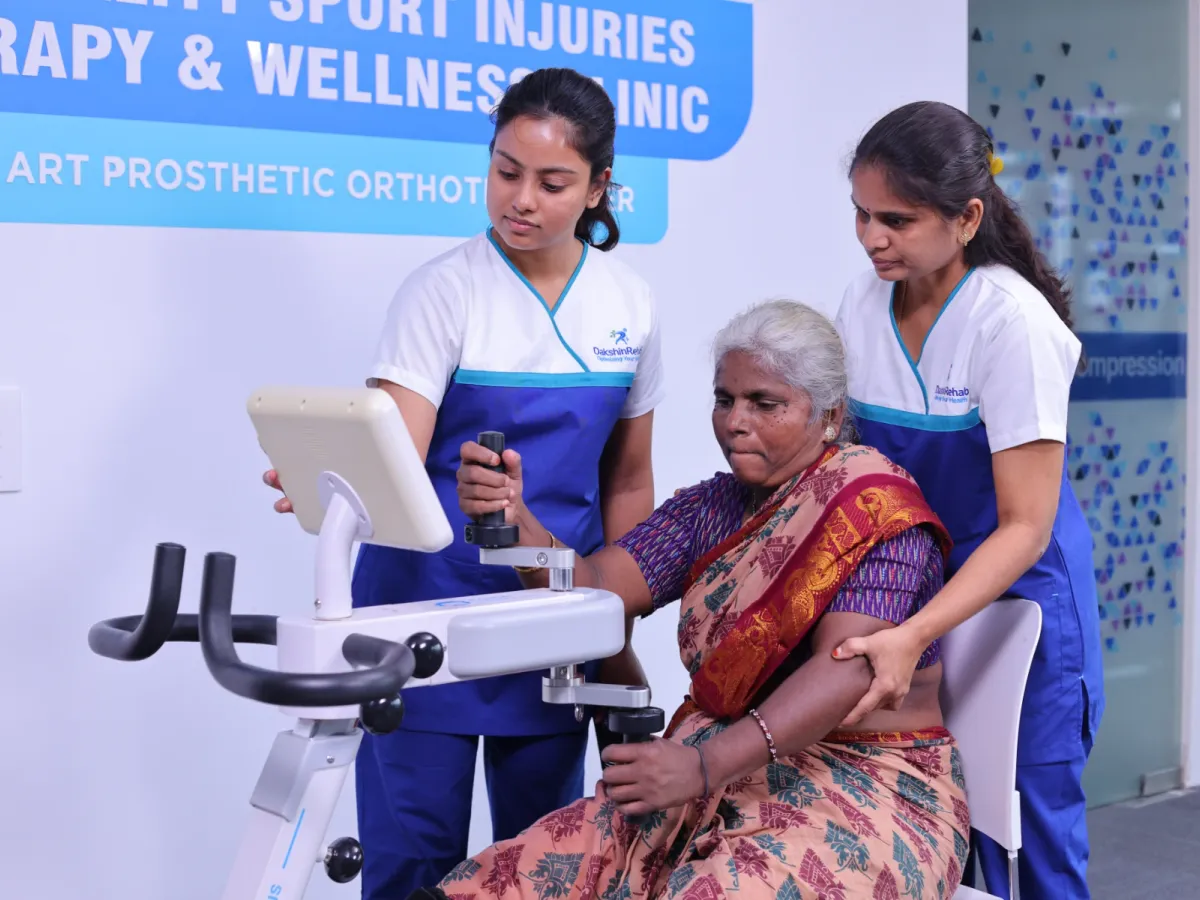
The robot moves the limb completely. Used in acute and subacute stages when patient has minimal or no voluntary movement. Prevents contractures and maintains ROM.

The robot assists only as much as needed. Patient initiates movement; the robot fills in the rest. Promotes motor learning and cortical reorganization.

The robot provides resistance against patient-initiated movement. Builds strength, improves motor control, and increases cardiovascular endurance.

Real-time on-screen feedback shows movement accuracy, symmetry, and effort. Gamified goals motivate patients to achieve higher repetition volumes.
Not sure which type you have?
Book an Assessment — We'll Diagnose It in Your First Session
RAGT improves walking speed, step length, and symmetry. Active mode shows superior neurophysiological outcomes vs passive mode in RCTs.
Learn more

Passive and active-assistive training maintains joint mobility, prevents osteoporosis, and stimulates spinal and supraspinal locomotor circuits.
Learn more
Cognitive-motor dual-tasking in robotic training addresses both physical and attentional deficits common in TBI recovery.
Learn more

Repetitive, controlled movement patterns help retrain aberrant motor patterns and improve gait efficiency in CP patients.
Learn more

Rhythmic auditory and visual cues combined with robotic guidance can reduce freezing of gait and improve stride length.
Learn more

Early, safe mobilization after brain tumor resection or spinal decompression prevents complications and accelerates functional return.
Learn more
Robotic gait and limb training is designed for neurological patients who need high-repetition, task-specific practice to rewire motor pathways.
Early robotic training (within 2–4 weeks post-stroke) significantly improves gait speed and motor function. Ideal for patients with severe paresis who cannot walk independently.
Body-weight support and robotic guidance enable safe stepping practice even with incomplete SCI — promoting neural regeneration and functional recovery.
Cognitive-motor dual-task training in robotic devices addresses both physical and attentional deficits common after traumatic brain injury.
Children with cerebral palsy benefit from repetitive, controlled gait patterns that retrain aberrant motor patterns and improve walking efficiency.
Neuroplasticity — the brain's ability to reorganize neural pathways — is driven by repetition, intensity, and task-specificity. The Cyclomotus delivers all three: thousands of precise movement repetitions at adjustable intensity, while the patient practices the actual task of walking.
The robot enforces physiologically accurate gait kinematics (hip flexion 30–40°, knee flexion 20–30°) at near-normal speeds, ensuring every repetition trains the correct pattern.
Adjustable unloading allows severely impaired patients to practice walking safely without the fear of falling, reducing compensatory strategies.
fNIRS studies show increased motor cortex activation in the affected hemisphere after active robotic training — evidence of neuroplastic change.
Smooth, continuous robotic movement prevents velocity-dependent spasticity triggers common in manual-assisted gait training.
The robot enforces physiologically accurate gait kinematics (hip flexion 30–40°, knee flexion 20–30°) at near-normal speeds, ensuring every repetition trains the correct pattern.
Adjustable unloading allows severely impaired patients to practice walking safely without the fear of falling, reducing compensatory strategies.
fNIRS studies show increased motor cortex activation in the affected hemisphere after active robotic training — evidence of neuroplastic change.
Smooth, continuous robotic movement prevents velocity-dependent spasticity triggers common in manual-assisted gait training.
A typical hospital physiotherapy session delivers 30–50 steps of gait practice. The Cyclomotus delivers 1,000+ repetitions per session. Research by Hidler et al. and systematic reviews confirm that higher repetition counts correlate with greater neuroplastic changes and functional recovery. At DakshinRehab, our inpatient neuro-rehab program combines 3–4 hours of daily robotic, suspension, and EMG training — versus 30 minutes in standard care.
Every session records steps, symmetry, range of motion, and active contribution percentage — objective data to guide clinical decisions.
DakshinRehab in Moosapet, Hyderabad is one of the few clinics offering robotic gait training for neurological rehabilitation. No hospital referral needed — our neuro-rehab specialists assess candidacy and design personalized protocols.

“The brain does not care about intention — it cares about repetition. Give me 1,000 correct steps on a robot, and I will show you a brain that has rewired itself to walk again.”
A Robotic Training Session at DakshinRehab
→Outcome: Individualized robotic protocol established
→Outcome: Patient safely positioned and robot calibrated
→Outcome: High-volume, correct repetitions completed
→Outcome: Improved voluntary motor control documented
→Outcome: Objective progress recorded; plan updated
The most advanced neuro-rehabilitation technology in Moosapet
Volume matters for neuroplasticity. The Cyclomotus delivers 20× more repetitions than conventional therapy in the same timeframe.
Every step is biomechanically correct — no compensatory patterns that create secondary problems.
From 100% passive guidance to full active resistance — the robot grows with your recovery.
Real-time data on steps, symmetry, range, and effort removes guesswork from rehabilitation planning.
Body-weight support and robotic guidance allow safe walking practice even with severe weakness or balance deficits.
fNIRS and MEP studies confirm active robotic training increases cortical activation and motor evoked potential amplitudes.
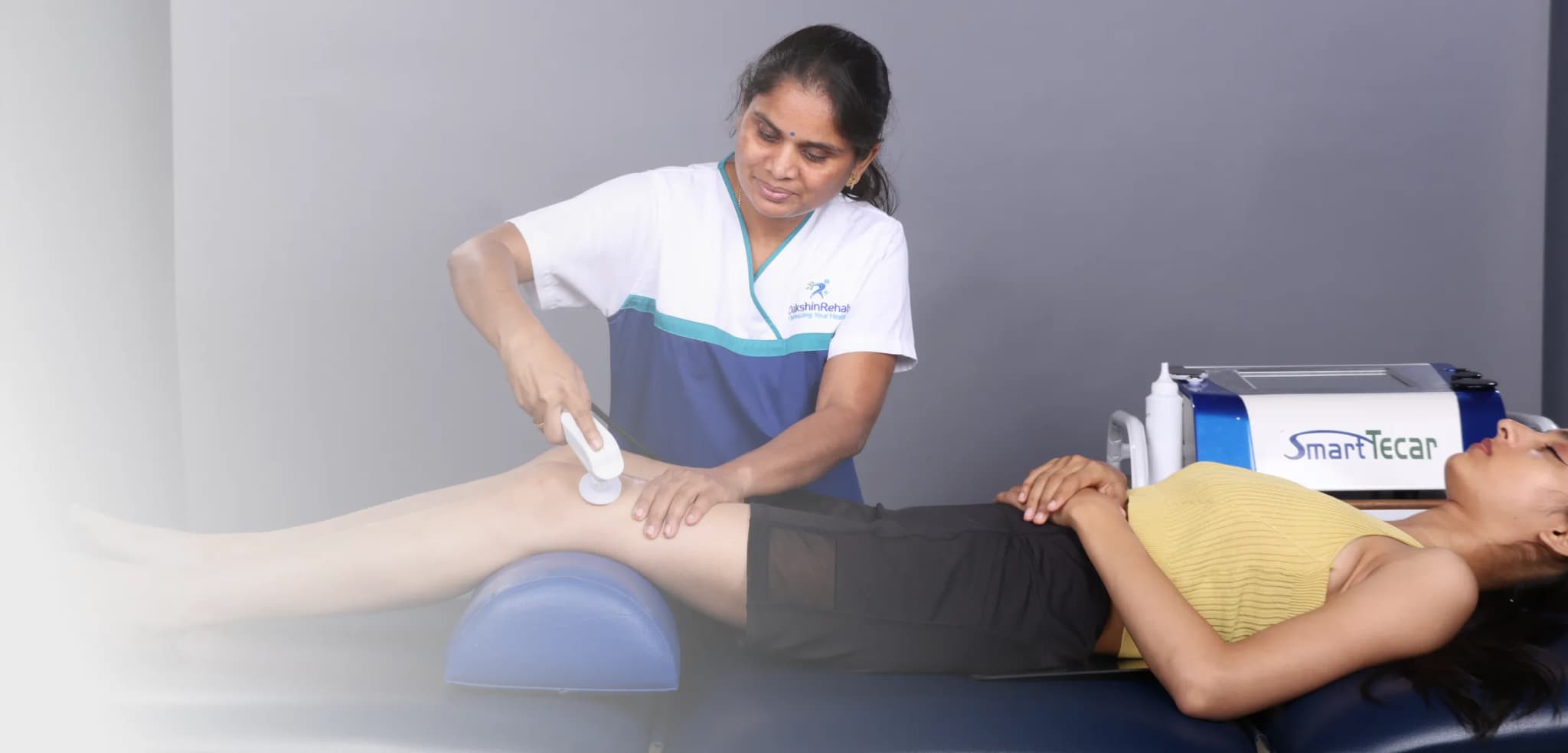
Robotic gait training is safe for most neurological patients, but certain conditions require medical clearance or avoidance.
Unstable fractures or non-union in the trained limb
Severe osteoporosis with fracture risk
Uncontrolled epilepsy or recent seizures
Unhealed surgical wounds or pressure ulcers
Severe fixed contractures that prevent orthosis fitting
Cardiovascular instability (uncontrolled BP, arrhythmia)
Severe cognitive impairment preventing compliance
Acute deep vein thrombosis
Our expert physiotherapists and rehabilitation specialists at DakshinRehab bring decades of combined experience to your recovery.
Director, Human MOVEMENT specialist Ortho Neuro Physiotherapist | Stroke & Spine Rehab Specialist

Consultant clinical rehabilitation services
Founder & Chief Prosthetist | Amputee Rehabilitation Expert

MS, MCh (Vascular Surgery)
Consultant Vascular Surgeon | Diabetic Foot & Wound Care
Learn more about this condition and treatment options from our expert team.
 Neuro Rehabilitation
April 24, 2026
Why the first 3–6 months after a stroke matter most — and how Redcord Neurac suspension therapy at DakshinRehab Moosapet uses graded unloading, vibration and closed-chain instability to drive the neuroplasticity that accelerates arm, leg and gait recovery.
Read More Neuro Rehabilitation
March 15, 2024
Why the first 6 months after a stroke matter most — and how DakshinRehab Moosapet phases neuro-physiotherapy, robotic gait, Redcord Neurac and EMG biofeedback across the acute, sub-acute and chronic stages to drive durable recovery of arm, leg, gait and independence.
Read More Neuro Rehabilitation
February 15, 2024
Spinal cord injury rehabilitation guide: comprehensive rehab, technology, multidisciplinary care. Expert guidance from Hyderabad.
Read More
This week only · Free assessment · ₹500 off
Join 20,000+ patients who went from painful to pain free. book this week and save ₹500 on your first session.
Book AppointmentHow high-intensity robotic rehabilitation compares to conventional neuro-rehab approaches
Traditional therapy provides 50–100 steps per session. Robotic training delivers 1,000+ steps with precise kinematics — the repetition volume required for meaningful neuroplastic change.
Learn MorePassive movement maintains joint flexibility but does not drive neuroplasticity. Robotic active-assistive mode requires patient effort, engaging motor learning circuits for lasting functional gains.
Learn MoreHome exercises lack the precision, repetition, and safety of robotic guidance. Incorrect movement patterns practiced at home reinforce compensatory strategies rather than true recovery.
Learn More