Non-Surgical Chronic Back Pain Treatment in Moosapet, Hyderabad
At DakshinRehab in Moosapet — a 5-minute walk from Moosapet Metro, serving Kukatpally, KPHB, Miyapur and Gachibowli — Dr. Swapnagandhi and our spine team treat long-standing and recurring lower back pain through individualised rehabilitation that addresses biomechanical, neuromuscular and behavioural drivers together. Our toolkit includes FDA-cleared spinal decompression, Redcord Neurac suspension training, manual therapy and a structured home programme. We serve patients across Hyderabad and from the Gulf region — UAE, Saudi Arabia, Qatar, Oman, Kuwait and Bahrain.
Clinical Focus — Long-Standing & Recurring Lower Back Pain
Non-Surgical Chronic Back Pain Treatmentin Moosapet, Hyderabad
At DakshinRehab in Moosapet — a 5-minute walk from Moosapet Metro, serving Kukatpally, KPHB, Miyapur and Gachibowli — Dr. Swapnagandhi and our spine team treat long-standing and recurring lower back pain through individualised rehabilitation that addresses biomechanical, neuromuscular and behavioural drivers together. Our toolkit includes FDA-cleared spinal decompression, Redcord Neurac suspension training, manual therapy and a structured home programme. We serve patients across Hyderabad and from the Gulf region — UAE, Saudi Arabia, Qatar, Oman, Kuwait and Bahrain.
Clinical Focus: Long-Standing & Recurring Lower Back Pain
Assessment-led care explained through 4 clinically relevant steps.
Understanding chronic back pain
Why Does Chronic Back Pain Rarely Fit Into One Box?
If your MRI doesn't reveal a dramatic finding but your back still hurts, it's not 'in your head' — it's how chronic pain actually works.
Chronic back pain rarely comes from a single dramatic injury.
Neuromuscular Activation Deficit
After months of pain, the deep core stabilisers (Transversus Abdominis, Multifidus) stop firing reliably — even if the muscles look strong on the outside.
Stiff, Inflamed Facet Patterns
Repeated sitting and lifting patterns lock the small facet joints between vertebrae, producing sharp pain when you lean backward or rise from sitting.
After months of pain, the deep core stabilisers (Transversus Abdominis, Multifidus) stop firing reliably — even if the muscles look strong on the outside. We retrain them with Redcord Neurac suspension training and EMG-guided Clinical Pilates so the spine has support when you move, sit and lift.
Facet Joints
Stiff, Inflamed Facet Patterns
Repeated sitting and lifting patterns lock the small facet joints between vertebrae, producing sharp pain when you lean backward or rise from sitting. We combine manual joint mobilisation with TECAR therapy to settle the inflammation and restore movement at the affected segments.
Sacroiliac Joint
SI Joint Dysfunction
Deep, one-sided buttock pain that mimics sciatica is often sacroiliac in origin. We use targeted stabilisation exercises, manual correction and dry needling when appropriate to settle the joint and restore symmetric load transfer through the pelvis.
Clinical Strategy
Our Lumbar Stabilization Protocol
We identify the drivers behind recurring pain and rebuild spinal resilience.
Step01
Segmental Motion Testing
We manually palpate each individual vertebra in your lower back to identify exactly which joints are physically stuck and which are hyper-mobile.
Through precise manual therapy, guided unloading and graded mobility work, we improve stiff spinal segments and help you bend, twist and return to daily activity more comfortably.
At DakshinRehab Moosapet, chronic low back pain care is planned around clinical assessment, movement findings and pain behaviour — not only short-term tablets or generic exercise sheets. Our spine team combines decompression, deep tissue technology and supervised core retraining to reduce pain, improve load tolerance and help you return to daily life safely.
TECAR Therapy
Deep radiofrequency therapy helps improve circulation and reduce protective spasm in thick paraspinal and hip muscles, making manual therapy and exercise more comfortable.
Computer-controlled spinal decompression is used when assessment suggests disc loading, nerve irritation or reduced spinal spacing may be contributing to persistent low back pain.
For selected patients, dry needling targets active trigger points in the lower back, gluteal and hip muscles to reduce pain-spasm-pain cycles and improve movement tolerance.
Supervised core retraining focuses on deep stabilisers such as the transversus abdominis and multifidus, so the spine is supported during real daily tasks.
Why technology is sequenced with hands-on spine rehabilitation
Medication can reduce symptoms for a short period, but recurring back pain often needs a mechanical and neuromuscular plan. At DakshinRehab, technology is used only when it supports the clinical goal: decompress irritated spinal structures, calm protective muscle spasm, restore segmental mobility, and rebuild the deep core system that protects your lower back during sitting, bending, lifting and walking.
Insight 1
Postural Ergonomic Training
Your sitting, lifting, work setup and daily movement habits are reviewed so the triggers behind recurring back pain are reduced outside the treatment room.
Located in Moosapet, Hyderabad, DakshinRehab serves Kukatpally, KPHB, Miyapur, Gachibowli and Gulf patients looking for non-surgical spine rehabilitation in India.
A real DakshinRehab SpineRelief session — combining technology-assisted therapy, movement retraining and pain neuroscience to rebuild pain-free function.
Real patient session at DakshinRehab Super Speciality Physiotherapy, Moosapet, Hyderabad
Treatment decision support
Injections vs Surgery vs Physiotherapy - Choosing the Right Path for Spine Pain
Spine pain can come from disc irritation, nerve compression, stenosis, posture-related overload, or movement sensitivity. Injections and surgery have specific indications, especially when symptoms and imaging match. For most patients, a root-cause physiotherapy assessment helps decide whether decompression, graded movement, strengthening, or medical referral is the safest next step.
“Spine treatment should not be chosen from an MRI alone. It should be chosen from the full picture - symptoms, movement, strength, nerve signs, and daily function.”
What happens from your first assessment through pain control, spinal decompression, core retraining and long-term prevention.
PHASE 1
Back Pain Assessment(45-75 min)
Pain behaviour and flare-up history
Lumbar movement and segmental screening
Posture, sitting and lifting pattern review
Clear map of the mechanical and lifestyle drivers behind your recurring back pain
PHASE 2
Care Plan & Education(15-20 min)
Diagnosis explained in plain language
Session plan and home precautions
Workstation, sleep and activity guidance
You understand what to change immediately and what the clinic plan will target
PHASE 3
Pain-Spasm Control(Week 1-3)
TECAR, shockwave or manual therapy as indicated
Gentle mobility without provoking flare-ups
Trigger-point and muscle-guarding reduction
Pain irritability reduces so movement becomes safer to retrain
PHASE 4
Spinal Decompression & Mobility(Week 3-6)
Lumbar decompression when clinically indicated
Facet and soft-tissue mobility work
Controlled bending, walking and transition drills
Reduced stiffness and better confidence during daily movements
PHASE 5
Deep Core Stability(Week 6-10)
Redcord Neurac activation work
Clinical Pilates for multifidus and deep core control
Progressive functional strengthening
Your spine starts relying less on guarding and more on active muscular support
PHASE 6
Prevention & Self-Management(Ongoing)
Personalised home exercise programme
Ergonomic and lifting strategy refinement
Flare-up plan for early symptom control
Lower recurrence risk and a practical plan for long-term spine health
When to Act Fast
Don't Ignore Severe Nerve Compression
Most chronic back pain is muscular or joint-related and perfectly safe to rehabilitate. However, if a disc collapses completely, it can crush the thick bundle of nerves at the base of your spine. Visit DakshinRehab in Moosapet immediately or head to an ER if you notice these absolute warning signs.
Saddle Anesthesia (Numbness) — If you suddenly lose all sensation in your groin, buttocks, or inner thighs (the areas that would touch a horse saddle).
Loss of Bladder or Bowel Control — Experiencing sudden, unexplained incontinence or the complete inability to urinate. This indicates Cauda Equina Syndrome, requiring immediate ER surgery.
Progressive Leg Weakness — If you repeatedly trip over your own foot ("foot drop") or your legs suddenly buckle out from underneath you without warning.
Unrelenting Night Pain — Back pain that wakes you from a dead sleep and is not relieved by adjusting positions in bed. This can be a sign of systemic issues or tumors.
Pain Accompanied by Unexplained Fever — Sudden severe back pain combined with a high fever or severe chills could indicate a deep spinal infection.
History of Cancer with New Back Pain — Any new, severe back pain in a patient with a previous history of cancer must be screened immediately to rule out metastasis.
Condition-relevant recovery stories from patients with different ages, jobs, family support and treatment goals — selected for this page while verified Google review imports are prepared.
Driving the daily commute again after 8 weeks of sciatica
Sharp pain ran from my lower back into my right calf, and I kept stopping during my Miyapur to Madhapur commute. My programme combined MRI review, decompression sessions, nerve-glide work and graded core training. By week eight, I could drive both ways and sit through client calls without the leg pain taking over.
IT project managerMaleCautious, report-led
SC
Sandeep Challa
Miyapur · 42 years
Morning stiffness no longer decides my whole day
I was frightened by the word degenerative on my scan and had stopped walking outside. The team explained what the MRI meant, then started gentle decompression, heat-based pain control and balance-safe strengthening. I now walk to the temple, cook without repeated chair breaks and know exactly which exercises settle a flare.
Retired school teacherFemaleFamily-supported
VN
Vasanthi Natarajan
Kukatpally · 68 years
Standing tolerance improved enough for site rounds
I could walk only a few minutes before heaviness spread into both legs. The plan focused on flexion-biased exercise, hip mobility, walking intervals and safe conditioning instead of forcing painful extension. I still respect my limits, but I can complete garage rounds and evening shopping without hunting for a chair every few minutes.
Watch DakshinRehab Moosapet patients describe how non-surgical spine decompression, laser therapy and Redcord (Neurac) helped them recover from disc and nerve-related back pain — without surgery.
01:30
“Avoided spine surgery at 72 — recovered in 21 days”
I was advised spine surgery for a severe L4-L5 disc bulge. The 21-day rehabilitation programme at DakshinRehab — combining non-surgical spine decompression, laser therapy, and Redcord — restored my mobility without an operation.
V
Vijaya Kumari
Lumbar Spondylosis & Disc Bulge
01:45
“Back pain and stiffness resolved — no surgery needed”
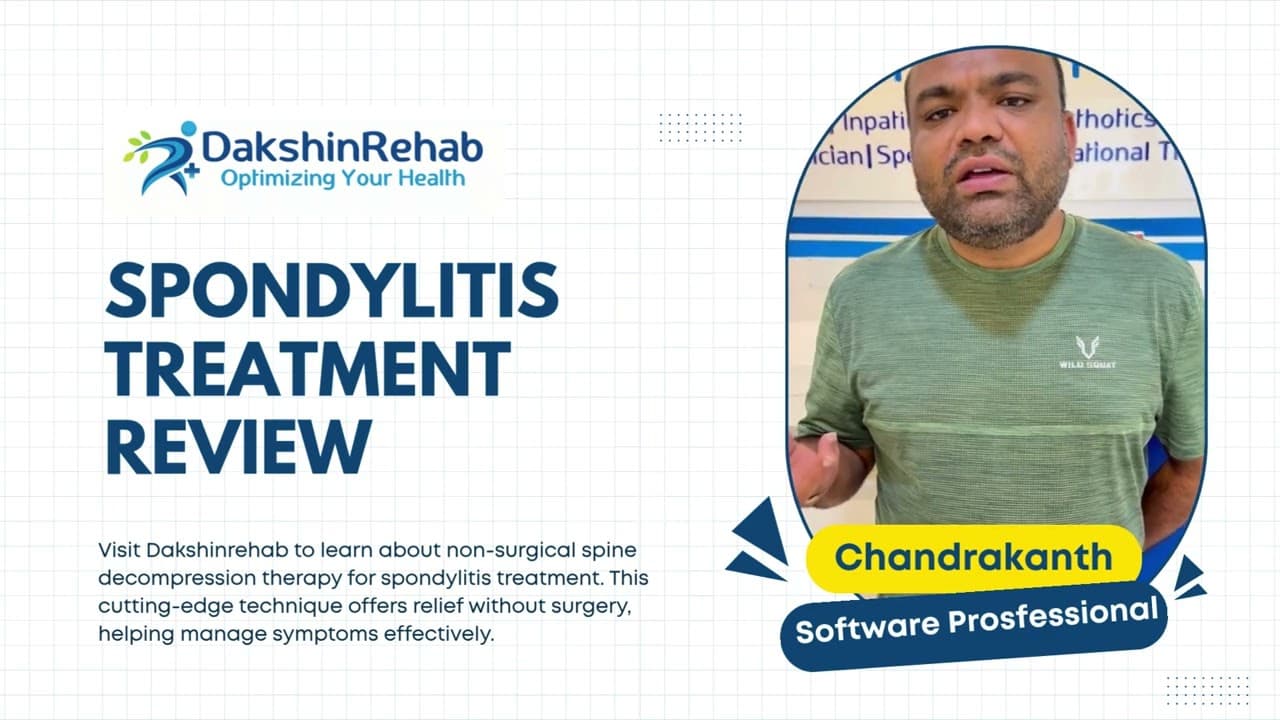
Spondylitis had left me with persistent back pain and stiffness. Non-surgical spine decompression, laser therapy, and Redcord (Neurac) therapy at DakshinRehab delivered significant pain relief and restored my mobility without any invasive procedures.
C
Chandrakanth
Spondylitis Recovery
Related Conditions
Related Conditions We Treat
Recurring low back pain can overlap with nerve, disc and mobility problems. DakshinRehab assesses the full chain so each patient is guided to the right spine-care pathway.
“Every treatment page should help patients understand what is safe, what is urgent, and what care path fits their condition. Clinical review keeps that advice practical and trustworthy.”
The clinical content on this page is written and independently reviewed by qualified physiotherapists at DakshinRehab, Moosapet, Hyderabad.
Chronic Back Pain FAQs
Chronic Back Pain Questions — Answered by Our Spine Specialists
Clear, clinician-reviewed answers to the questions our patients in Hyderabad and the Gulf region most often ask about long-standing and recurring lower back pain.
Why does my back pain keep coming back?
Recurring back pain usually means the underlying cause was not fully addressed in earlier treatment. Common reasons include weak deep core stabilisers, poor sitting and lifting habits, unresolved disc or facet issues, and central sensitisation — where the nervous system stays alert to pain even after tissue has healed. At DakshinRehab in Moosapet, we assess all four drivers before designing your programme so the pain does not return after short-term relief.
How long is back pain considered chronic?
Can chronic back pain be treated without surgery?
What's the best physiotherapy clinic for chronic back pain in Hyderabad?
Do I need an MRI if my back pain has lasted years?
Should I stop exercising if my back hurts?
Is sitting at a desk damaging my back?
Can stress or poor sleep affect chronic back pain?
How is chronic low back pain different from a herniated disc?
What does a typical chronic back pain programme look like at DakshinRehab?
How much does chronic back pain treatment cost at DakshinRehab?
Do you treat international patients with chronic back pain?