An anterior cruciate ligament (ACL) tear is the moment that ends seasons, costs scholarships and ends amateur careers. We see it every week at DakshinRehab in Moosapet, Hyderabad — the cricketer who pivoted on a wet pitch, the footballer who landed awkwardly, the weekend badminton player whose knee gave way during a lunge. The tear takes a fraction of a second; the recovery takes 9 to 12 months. And the single most important factor determining whether an athlete returns to sport stronger or tears the same knee again is not the surgical technique — it is the rehabilitation that follows. Our ACL reconstruction rehabilitation programme combines pre-operative prehab, structured biological-timeline post-op care, EMG biofeedback for arthrogenic muscle inhibition, Redcord Neurac for neuromuscular control, and rigorous criterion-based limb symmetry testing for return-to-sport clearance.
What an ACL tear actually is — and why it matters
The ACL is one of four major knee ligaments connecting the femur to the tibia, controlling forward translation of the tibia and rotational stability. ACL tears occur during sudden deceleration, pivoting on a planted foot, landing from a jump, or direct knee trauma — most commonly in cricket, football, basketball, badminton and gym training. The classic story is a non-contact pivot followed by a popping sensation, immediate swelling within 2 to 4 hours, and a sense that the knee 'gave way'. Most ACL tears are complete; partial tears can sometimes be managed without surgery in lower-demand patients but rarely in athletes returning to pivoting sports. An untreated complete ACL tear in an active athlete typically leads to recurrent giving-way, secondary meniscus tears, and accelerated knee osteoarthritis over the following 5 to 15 years.
How we assess ACL-injured patients properly at DakshinRehab Moosapet
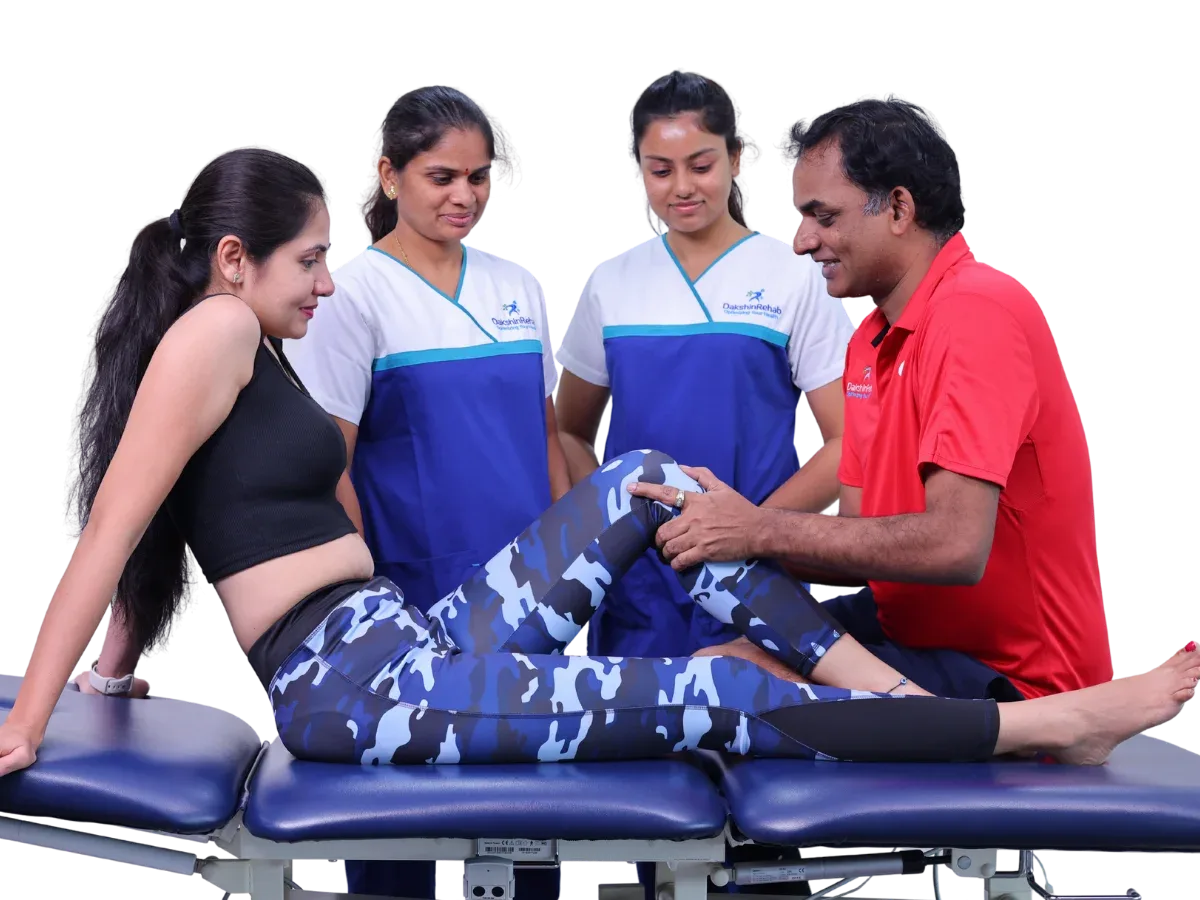
A first visit runs 60 to 90 minutes. We take a detailed mechanism-of-injury history (very important because non-contact pivot injuries have higher re-injury risk than contact injuries). We perform clinical examination — Lachman's test (most sensitive for ACL), pivot shift, anterior drawer, plus tests for associated meniscal and collateral ligament injuries. We measure baseline range of motion, swelling and quadriceps strength. We coordinate same-week MRI through our partner radiology centres in Kukatpally and KPHB if not already done. We score validated outcome measures — Lysholm, IKDC, Tegner activity level. We discuss surgical versus non-surgical management openly — for elite athletes returning to pivoting sports, reconstruction is almost always indicated; for some recreational patients with low-demand goals, structured non-surgical rehabilitation is a viable option supported by current literature.
Why pre-operative prehab matters and what it involves
Pre-operative physiotherapy ('prehab') in the 4 to 6 weeks between injury and surgery is one of the highest-leverage interventions in modern ACL rehabilitation. Prehab achieves three things — full restoration of knee range of motion (so post-op stiffness is less of an obstacle), pre-operative quadriceps strength building (so post-op AMI starts from a higher baseline), and reduction of swelling (so the knee enters surgery in optimal condition). Patients who complete a structured prehab programme typically achieve post-op milestones 2 to 4 weeks faster than those who go to surgery 'cold'. DakshinRehab Moosapet runs prehab programmes that include manual therapy, NMES, single-leg progression, cryotherapy, and patient education on what to expect post-op so the operative day arrives prepared.
How early-phase post-op rehabilitation works (Weeks 0–4)
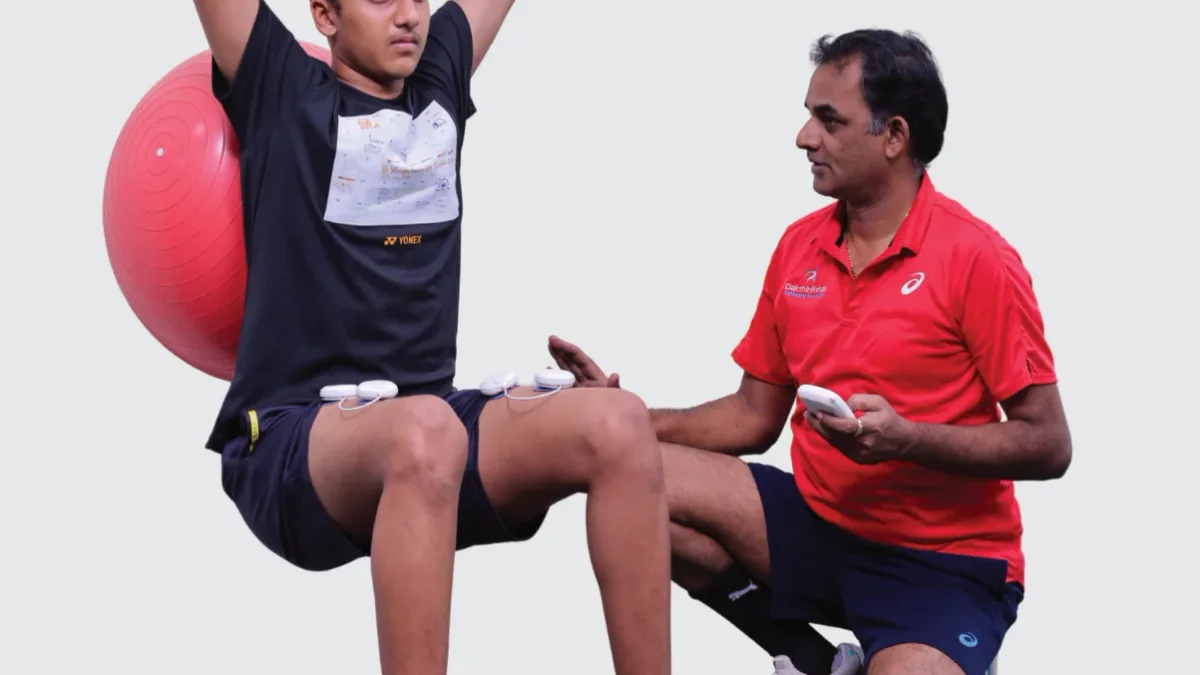
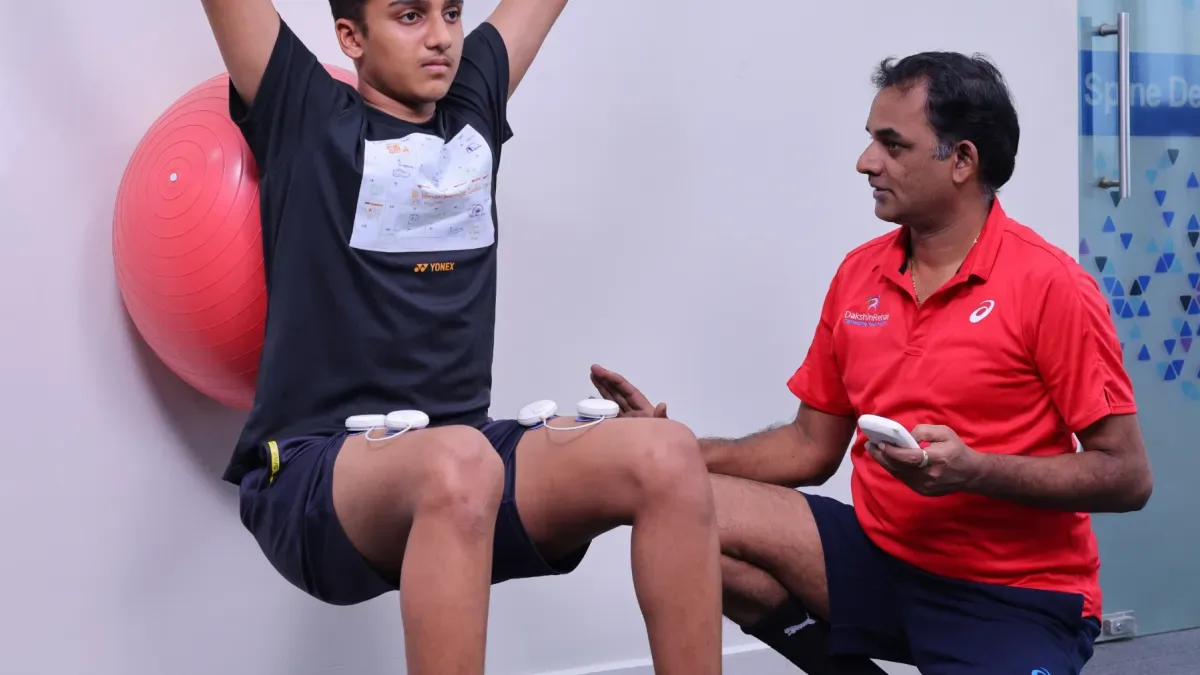
Pain and swelling control is the priority alongside aggressive prevention of arthrogenic muscle inhibition (AMI) — the protective shutdown of the quadriceps that, if not addressed, leaves patients with weak quads for years. We use Chattanooga Wireless Pro FES from day one, with electrical stimulation activating the inhibited quadriceps while the patient attempts voluntary contraction. EMG biofeedback shows the patient real-time quadriceps activation, retraining the brain-muscle connection that surgery temporarily disrupts. Full passive knee extension is the non-negotiable target by Week 2 — patients who fail to achieve full extension early are at risk of permanent flexion contracture. Cryotherapy and lymphatic drainage manage swelling. The graft is protected — no open-chain knee extension between 30 and 90 degrees in the early phase due to ACL strain biomechanics.
How intermediate-phase rehabilitation builds strength and neuromuscular control (Weeks 4–12)
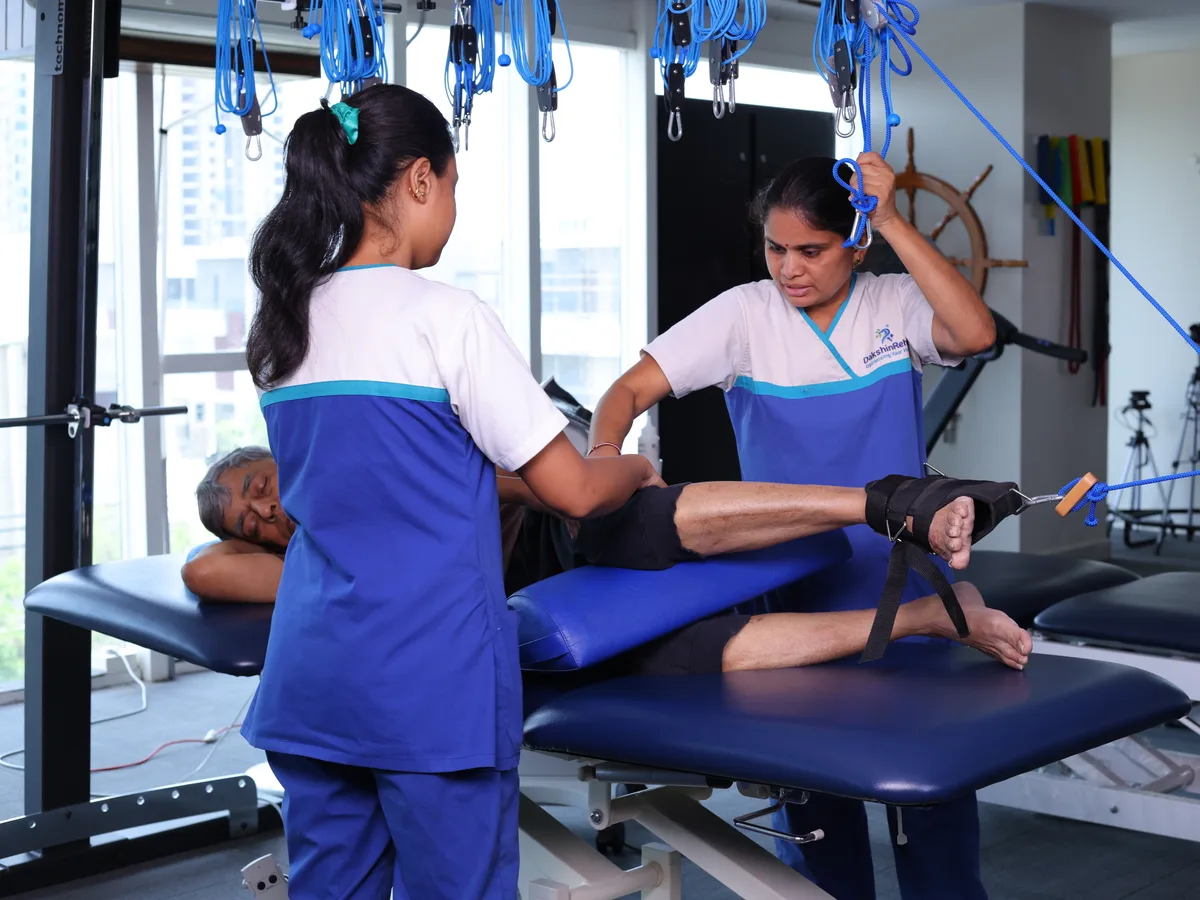
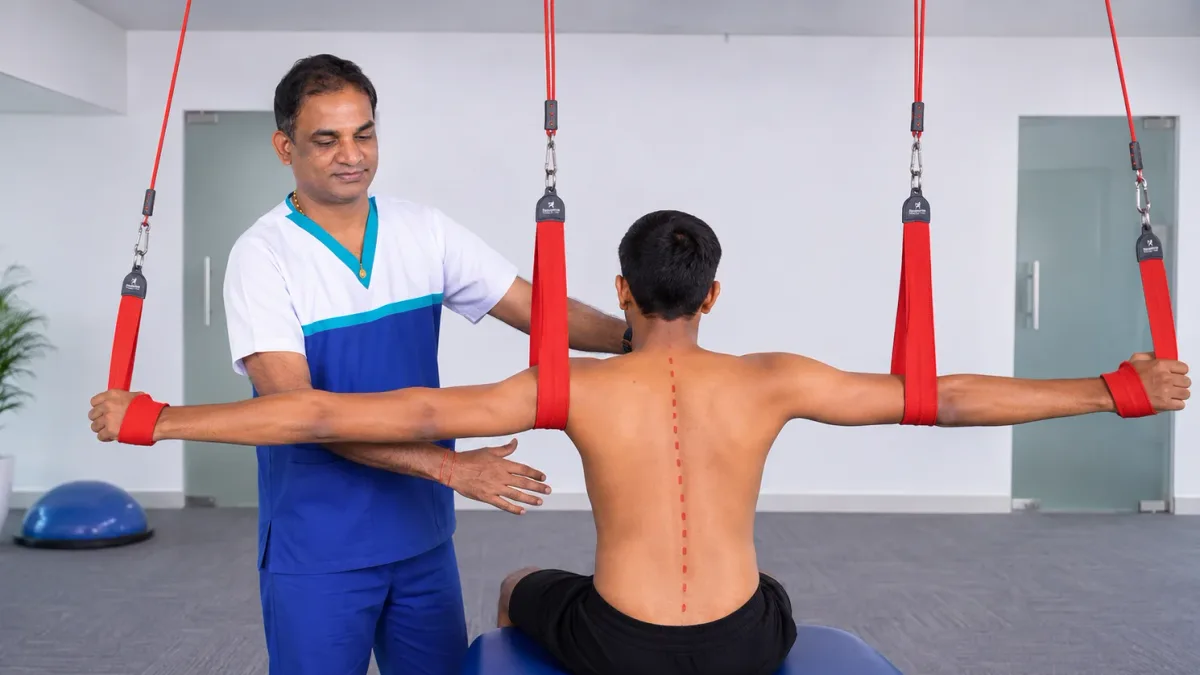
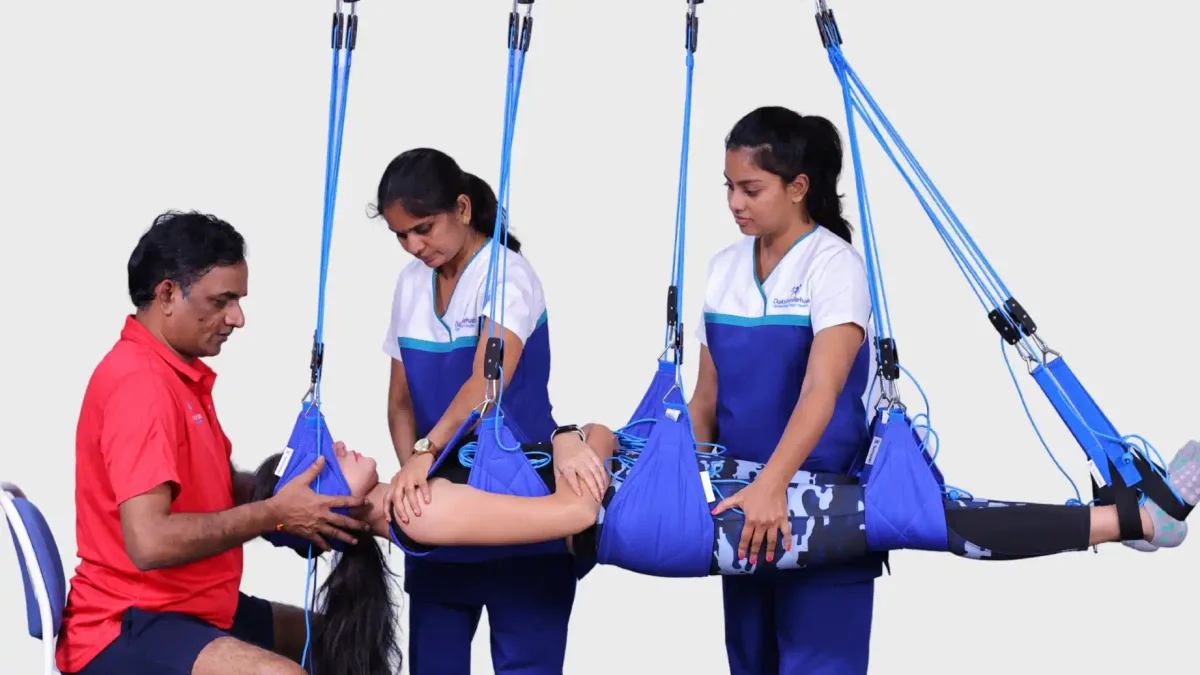
Progressive closed-chain strengthening becomes the centrepiece. Redcord Neurac suspension therapy is invaluable here — it allows pain-free, graded loading of the operated leg in functional positions, with vibration recruitment of deep stabilisers that voluntary effort alone cannot achieve. Stationary cycling progresses to mini-squats, then progressive single-leg work, then step-ups and step-downs, then split squats. Hamstring strengthening is critical (hamstrings co-contract with quadriceps to protect the ACL). Proprioception training on unstable surfaces rebuilds the joint position sense the surgery disrupted. By Week 12, most patients achieve full range of motion, walk without limp, and have measurable quadriceps strength returning to within 30 percent of the non-operated leg.
Why the late phase requires plyometrics, agility and sport-specific drills (Months 3–6)
The transition from gym-based strengthening to sport-specific movement is where many rehabilitation programmes fail — and where re-injury risk peaks. We progress from double-leg jumping to single-leg jumping, then horizontal hops, vertical hops, lateral hops. We add change-of-direction drills, deceleration training, and sport-specific cutting patterns. For cricketers, we work on bowling delivery stride mechanics. For footballers, we layer in cutting and sprinting. For badminton and tennis players, we work on lateral lunges and overhead jumps. The goal is graded re-exposure to the exact mechanics that injured the knee in the first place, building neuromuscular tolerance progressively rather than throwing the patient back into uncontrolled sport.
How return-to-sport clearance must be criterion-based, not calendar-based
This is the single most important principle in modern ACL rehabilitation, and the one most often violated. Published research is clear — returning to pivoting sport before achieving objective milestones dramatically increases second-ACL injury risk. Calendar-based clearance ('it's been six months, you can play') is a relic of an earlier era. DakshinRehab Moosapet uses a structured return-to-sport battery — limb symmetry index above 90 percent for quadriceps and hamstring strength measured by hand-held dynamometer; single-leg hop tests (single hop for distance, triple hop, crossover hop, timed 6-metre hop) all above 90 percent symmetry; Y-balance test for dynamic stability; psychological readiness assessed with the ACL-RSI questionnaire. Patients who pass all components have second-ACL injury rates 3 to 5 times lower than those cleared on calendar alone.
Evidence and expected outcomes from the published literature
ACL rehabilitation is one of the most studied areas in sports physiotherapy. Grindem et al. demonstrated that for every month return-to-sport was delayed up to 9 months post-op, second injury risk dropped by 51 percent. Wiggins systematic review showed that limb symmetry below 90 percent at clearance multiplies re-tear risk significantly. Kvist work on psychological readiness showed that fear of re-injury (kinesiophobia) is itself a re-injury risk factor independent of physical readiness. The MOON cohort and Delaware-Oslo trial both support criterion-based progression. DakshinRehab tracks every patient against these validated benchmarks — Lysholm, IKDC, Tegner, hop test ratios, ACL-RSI — so progress is measurable, and clearance decisions are data-driven rather than wish-driven.
How DakshinRehab integrates ACL care with the wider knee and sports pathway
ACL rehabilitation rarely exists in isolation. We commonly co-manage with associated meniscus tears (often surgically addressed at the same time), patellofemoral pain that develops during the rehabilitation period, hip-strength deficits that contributed to the original injury, and ankle stiffness that compromises landing mechanics. For young athletes, we coordinate with parents and coaches on training load management, return-to-school-PE timelines, and graded re-exposure to competitive sport. For adult recreational athletes from Madhapur, Gachibowli and Hitec City — many of whom are weekend cricketers and footballers — we balance rehabilitation intensity with work and family demands so the programme fits real life.
When ACL recovery needs urgent medical attention — the red flags
Most ACL rehabilitation proceeds smoothly, but certain symptoms require immediate medical evaluation rather than continued physiotherapy. Sudden severe knee swelling weeks or months post-op may indicate graft failure or infection. Sudden mechanical locking that was not present before suggests a new meniscal tear or loose body. New onset of giving-way (after a period of stability) raises concern for graft re-tear. Fever above 38°C with knee redness or wound drainage is an infection emergency. Calf pain with swelling may indicate deep vein thrombosis. DakshinRehab screens for all these red flags at every session and routes patients straight back to the operating surgeon when indicated.
What a typical ACL rehabilitation timeline looks like at DakshinRehab Moosapet
Pre-op prehab runs 4 to 6 weeks (more if surgery can be delayed). Phase 1 (Weeks 0–4 post-op) is protective — full extension, quadriceps activation, swelling control. Phase 2 (Weeks 4–12) is progressive loading — closed-chain strengthening, Redcord Neurac, stationary cycling progressing to mini-squats. Phase 3 (Months 3–6) is sport preparation — plyometrics, agility, sport-specific drills. Phase 4 (Months 6–9) is return-to-sport testing — limb symmetry, hop tests, psychological readiness. Phase 5 (Months 9–12+) is graded sport reintegration with continued strength work. Sessions are 45 to 60 minutes, 2 to 3 times per week, one-on-one with a qualified physiotherapist. Total session count typically runs 60 to 100 across the full 9 to 12 month programme.
Conclusion — return to sport stronger, not just sooner, at DakshinRehab Moosapet
An ACL tear is not a career-ender — but a rushed rehabilitation can be. The combination of biological graft healing time (which cannot be shortcut), criterion-based testing (which cannot be skipped), and technology-assisted recovery (which dramatically improves outcomes) is what gets athletes back to sport at full capacity rather than into a second tear. At DakshinRehab in Moosapet, Hyderabad, we combine pre-op prehab, structured post-op phases, EMG biofeedback for AMI, Redcord Neurac for neuromuscular control, and limb symmetry testing for return-to-sport clearance — the same standard used by elite sports rehabilitation centres worldwide. We serve cricketers, footballers, badminton players and weekend athletes from Moosapet, Kukatpally, KPHB, Miyapur, Madhapur, Gachibowli, Hitec City, plus international patients from the Gulf travelling for advanced ACL recovery. Book your ACL assessment, WhatsApp us on +91 80192 99888, or call +91 80192 99888. The knee that tore once does not have to tear again.