Chronic back pain is the single most common musculoskeletal complaint we see at DakshinRehab in Moosapet, Hyderabad. It is the IT professional from Madhapur who wakes up stiff every morning. It is the mother in KPHB who cannot pick up her toddler. It is the 60-year-old from Kukatpally told they need spine surgery. And in the vast majority of those cases — by the weight of international evidence — structured physiotherapy with the right technology beats painkillers and surgery on every outcome that matters: pain, function, recurrence and cost. This guide explains what chronic back pain actually is, why so many patients fail to recover despite months of generic treatment, and how DakshinRehab combines spinal decompression, Redcord Neurac, EMG biofeedback and 3D movement analysis to break that cycle for good.
What chronic back pain actually is — and why it is different from acute pain
Chronic back pain is defined internationally as pain lasting more than 12 weeks, even after the initial injury or pathology has had time to settle. It is fundamentally different from acute pain. Acute pain is a tissue signal — something is damaged, protect it, heal it. Chronic pain is a nervous-system signal — the tissue may have healed but the brain and spinal cord are still producing pain because the alarm system has become sensitised. That is why so many chronic back patients have normal or mildly abnormal MRIs yet crippling symptoms, and why simply treating a disc bulge on imaging often fails to fix their pain. Modern guidelines from NICE, the American College of Physicians and the Lancet Low Back Pain Series are unanimous — chronic back pain requires a whole-system approach (tissue + nervous system + behaviour + biomechanics), not a single intervention.
Why so much back pain fails to heal in Hyderabad specifically
Four contributors show up again and again at our Moosapet clinic. First, prolonged sitting in IT and finance jobs across Madhapur, Gachibowli, Hitec City and the Financial District — commonly 8 to 10 hours per day with poor workstation ergonomics. Second, deconditioned deep-core and gluteal muscles because there is no time or habit of regular exercise outside weekends. Third, rising BMI in the urban Hyderabad population, which multiplies the load on every lumbar disc. Fourth, high stress levels in competitive work environments, which amplify pain perception through well-documented neuroinflammatory mechanisms. Traditional physiotherapy that prescribes hot packs, ultrasound and a few generic stretches addresses none of these root drivers — which is why back pain returns within weeks of finishing therapy, or never really goes away.
What are the six main patterns of chronic back pain we see
Mechanical back pain from strained muscles, ligaments or discs worsens with movement and eases with rest. Discogenic pain from degenerated or bulging intervertebral discs is deep and achy, worse with sitting, bending forward or lifting. Facet joint pain from small posterior spinal joints gives localised tenderness and morning stiffness. Myofascial pain from trigger points in tight muscles is extremely common in Hyderabad's IT workforce due to sustained posture. Radicular pain (sciatica) is a sharp, shooting pain down the leg from compressed nerve roots, often with numbness, tingling or weakness — see our dedicated guides on sciatica and disc bulge / herniated disc. Spinal stenosis in older adults narrows the spinal canal, causing leg pain with walking that eases when sitting or bending forward. Each of these patterns needs a different treatment pathway — the mistake most patients have had before reaching us is being given the same generic exercise sheet regardless of pattern.
How DakshinRehab's structured back pain assessment works
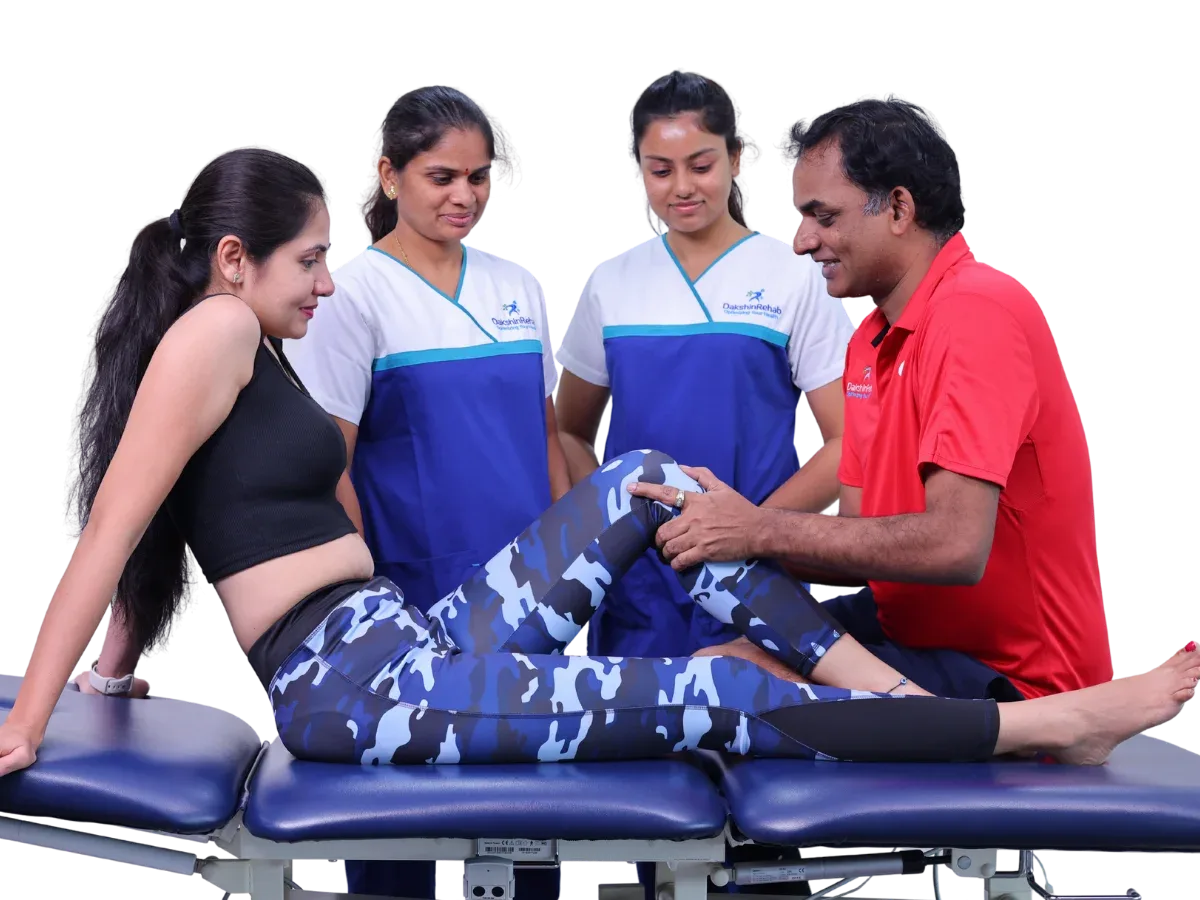
A first visit at our Moosapet clinic runs 60 to 90 minutes and is nothing like a brief outpatient review. We take a detailed pain history (onset, location, quality, aggravating and relieving factors, previous treatments, medications, imaging). We perform a full clinical examination — movement testing, posture analysis, neurological screening for reflexes, sensation and strength, and specific tests to differentiate disc, facet, nerve-root and sacroiliac joint involvement. We run 3D movement analysis to catch the biomechanical faults (forward head, rounded shoulders, anterior pelvic tilt, hip flexor tightness) that a visual assessment alone misses. We score validated outcome measures — Oswestry Disability Index, Numeric Pain Rating Scale, Fear-Avoidance Beliefs Questionnaire — so progress is objective, not anecdotal. Where imaging is needed but missing, we coordinate same-week MRI through our partner radiology centres.
Why spinal decompression is a first-line tool for disc and sciatica patients at DakshinRehab
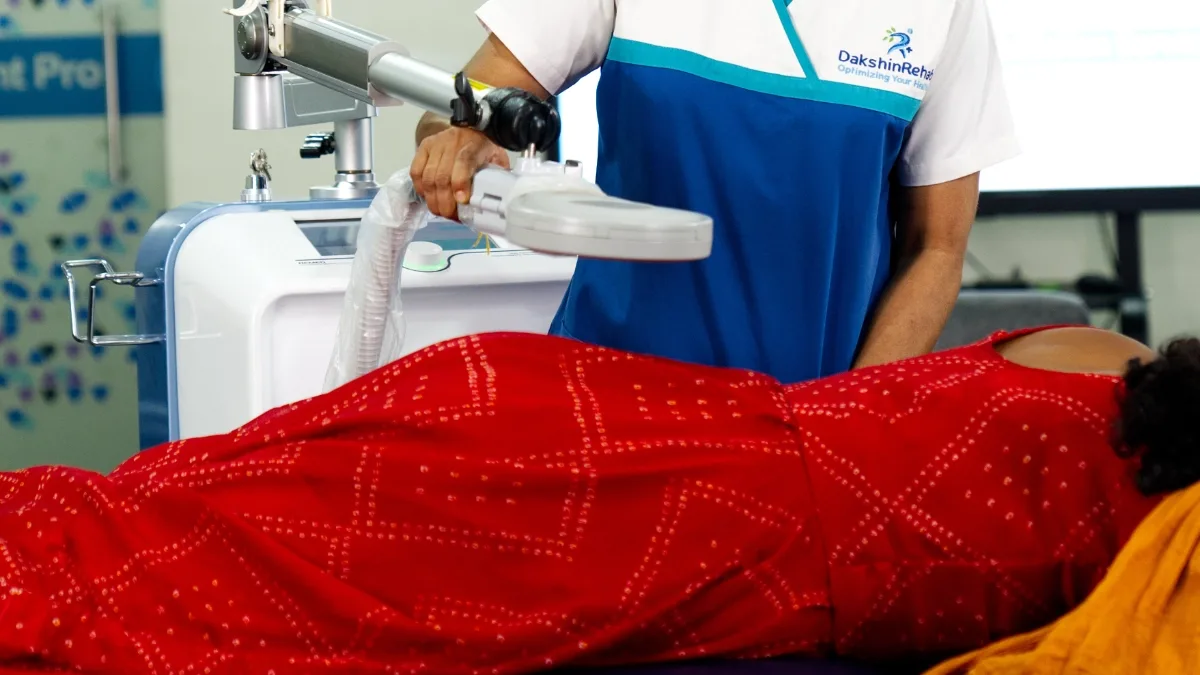
For discogenic pain and sciatica, spinal decompression therapy using our Chattanooga DTS computer-controlled system is often the single highest-impact intervention. The table applies precisely graded axial traction at angles and forces matched to your specific disc level, creating negative pressure within the target disc. That negative pressure retracts herniated or bulging disc material, reduces mechanical pressure on the nerve root, and pulls nutrients and fluid back into the disc — which does not normally receive blood supply in adults. Most patients feel measurable sciatic pain relief within 3 to 6 sessions; a typical course is 20 sessions over 4 to 6 weeks. Decompression is not a standalone fix — it is paired with Redcord Neurac and core stabilisation so the underlying instability that produced the disc problem is corrected alongside the symptomatic relief.
How Redcord Neurac reactivates the deep core that sit-ups cannot reach
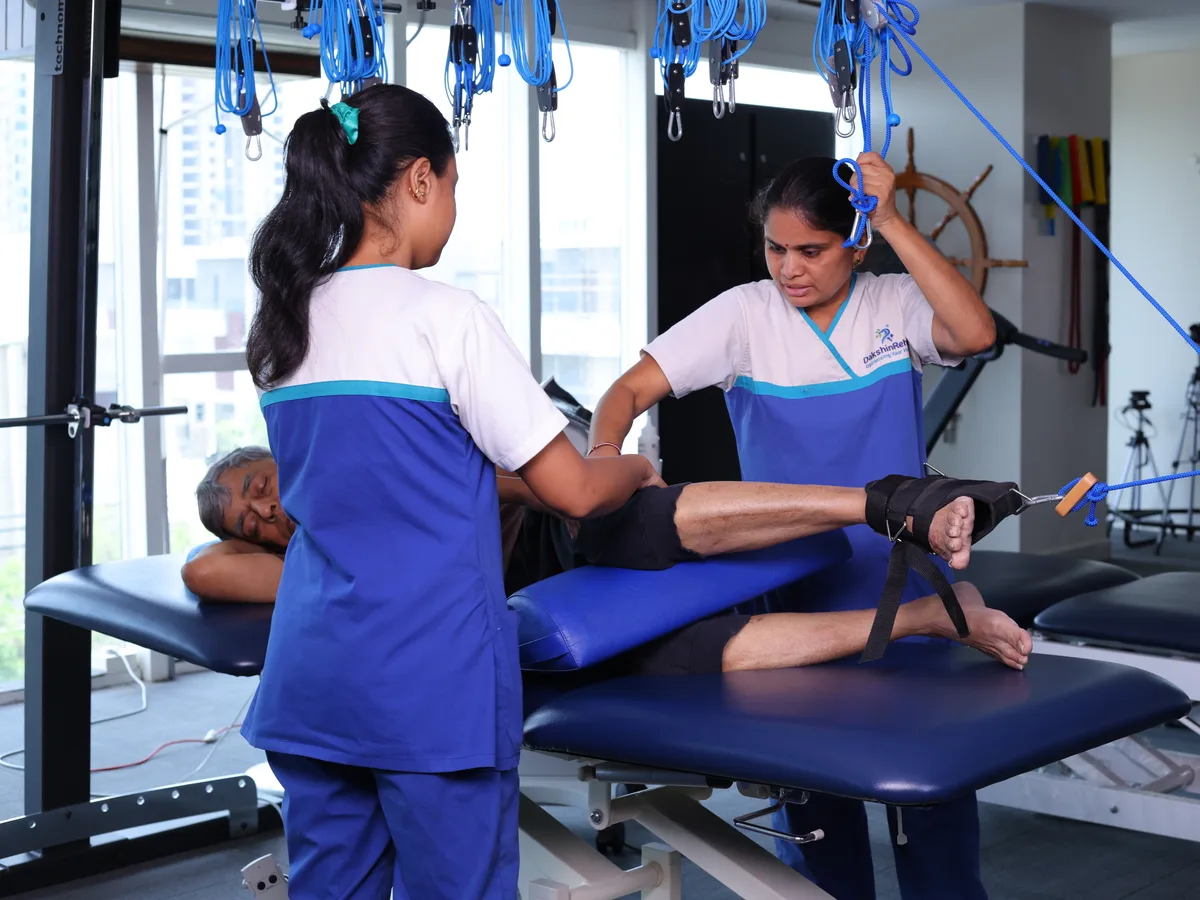
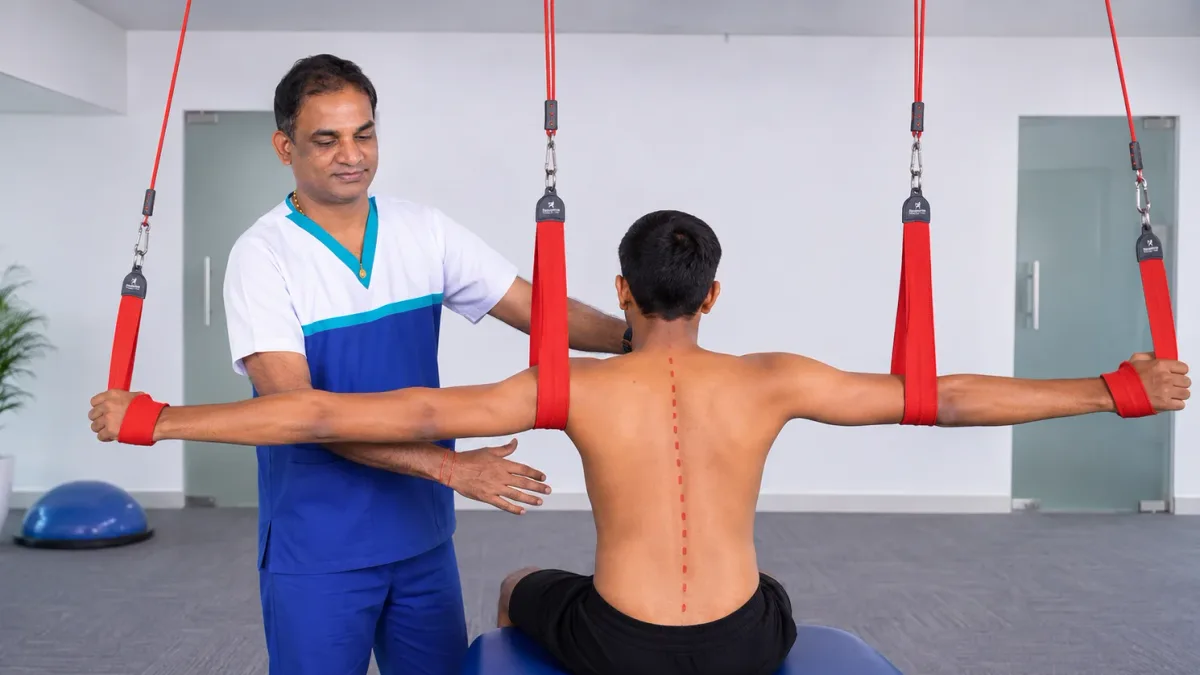
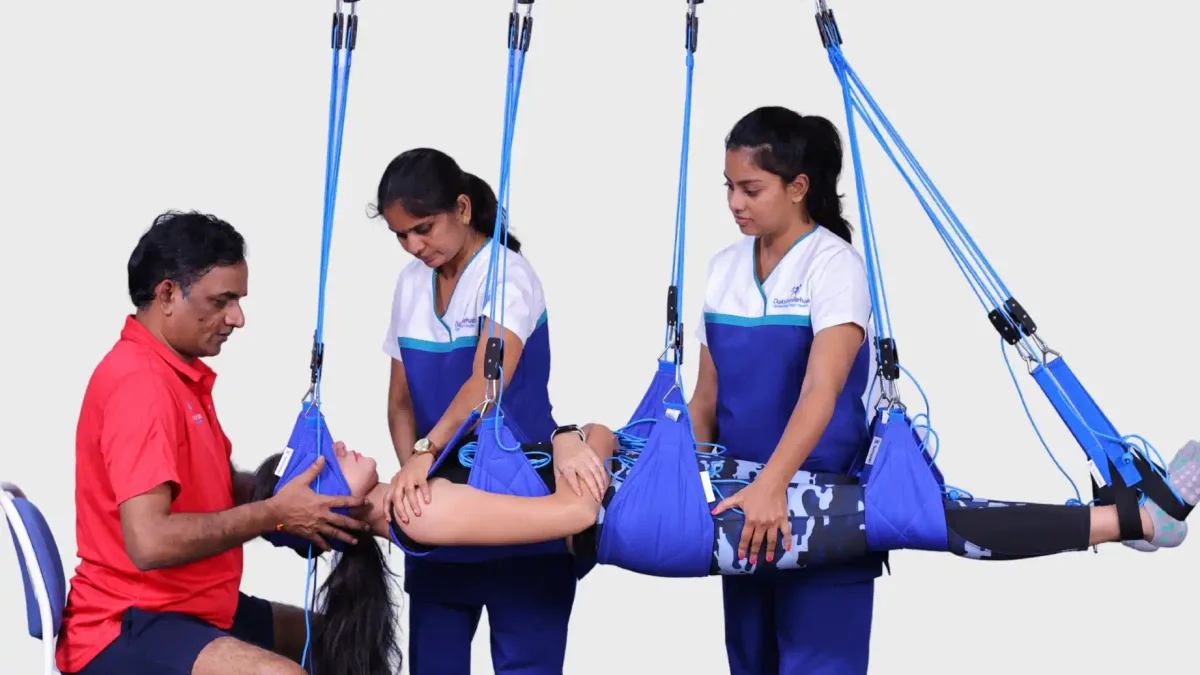
Every chronic back patient who walks into DakshinRehab has the same core weakness — not a weakness in rectus abdominis or erector spinae (the visible muscles) but in multifidus, transversus abdominis, diaphragm and pelvic floor (the deep segmental stabilisers). These slow-twitch stabilisers are switched off by a phenomenon called arthrogenic muscle inhibition whenever the spine is painful or unstable. Sit-ups and planks cannot wake them up because voluntary effort recruits the global muscles preferentially. Redcord Neurac solves this by loading the deep stabilisers reflexively through closed-chain instability in suspension, amplified by Stimula vibration at 40 to 50 Hz. Patients routinely report feeling their lower abdominals and deep back muscles work for the first time in years during their first session. See our dedicated explainer on Levitas Neurac and deep core reactivation for the full mechanism.
What manual therapy, McKenzie and functional exercise add to the pathway
Hands-on manual therapy — spinal mobilisation, targeted manipulation where appropriate, myofascial release, neural mobilisation and trigger-point work — restores joint mobility, reduces muscle tone and gives the nervous system a clear signal that the back is safe to move. The McKenzie Method directionally categorises your pain and prescribes movements (usually extension) that centralise pain from the leg back toward the spine, a strong predictor of good outcomes in disc patients. Progressive functional exercise then rebuilds load tolerance in real-life positions — deadlifts scaled to your capacity, hip hinging, squat patterning, carries — because the patient who cannot lift a grocery bag or pick up a grandchild is the patient whose pain keeps returning. Every exercise at DakshinRehab is prescribed with a specific purpose; there are no junk repetitions.
How ergonomic and behavioural work completes the programme
Chronic back pain is never only physical. At DakshinRehab Moosapet, every back pain programme includes pain neuroscience education — teaching patients why chronic pain does not equal ongoing damage, why movement is safe and why stress amplifies pain. We conduct workstation ergonomic reviews for IT professionals — chair height, lumbar support, monitor at eye level, keyboard and mouse within easy reach, recommendations for sit-stand desks, and structured movement breaks every 30 to 45 minutes. We address sleep position, mattress firmness (medium-firm wins for most adults), smoking (which impairs disc nutrition), weight management, and stress-reduction techniques. For Hyderabad patients, we provide culturally relevant adaptations — safer ways to perform floor-based activities, traditional seating modifications, and exercise prescriptions that fit into a working parent's schedule. Our posture correction guide is used alongside clinic sessions.
When do you actually need spine surgery
Surgical referral at DakshinRehab is reserved for specific, well-defined indications — progressive neurological deficits (worsening foot drop, saddle numbness), cauda equina syndrome (which is a medical emergency), severe spinal stenosis unresponsive to 3 to 6 months of comprehensive conservative care with major functional limitation, structural instability, or documented structural pathology that has failed a full conservative trial. Even in these cases, we co-manage with spine surgeons at KIMS, Yashoda, Apollo and Care Hospitals across Hyderabad — preparing you pre-operatively and taking over rehabilitation post-operatively. The honest truth is that most chronic back patients who were told they needed surgery, and who try a structured conservative programme first, recover without ever needing it. The opposite — surgery without rehabilitation — has a much poorer track record.
Evidence and expected outcomes from the published literature
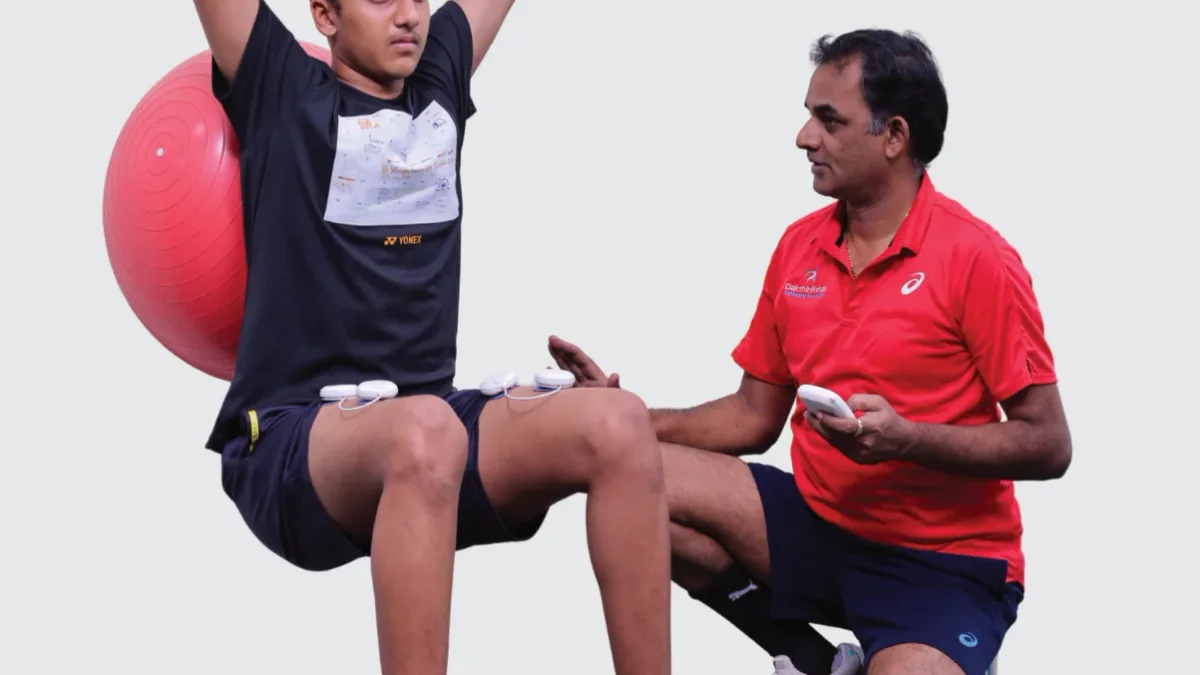
The chronic back pain evidence base is mature. The Lancet Low Back Pain Series (2018) concluded that exercise therapy is the single most effective intervention for chronic low back pain and that over-reliance on imaging, opioids and surgery has actively harmed patients. Cochrane reviews show that combining manual therapy with structured exercise produces larger and longer-lasting improvements than either alone. Spinal decompression trials show high rates of symptom resolution in disc-herniation populations with sciatica. Redcord Neurac trials from Norway show superior outcomes at 3, 6 and 12 months compared with general exercise for chronic non-specific low back pain. At DakshinRehab, we track every patient against these validated benchmarks — Oswestry Disability Index, pain scores, return-to-work timelines and recurrence rates — so your progress is measurable.
What a typical DakshinRehab chronic back pain programme looks like
Week 1 to 2 is pain control and assessment — manual therapy, spinal decompression where indicated, Neurac weak-link testing, pain education, medication review. Week 3 to 6 is the active phase — progressive Neurac deep-core reactivation, McKenzie directional exercises, ergonomic correction, 2 to 3 sessions per week. Week 7 to 12 is functional integration — progressive loading, sport- or work-specific drills, return-to-activity testing. Month 4 to 6 is maintenance — one session every 2 to 3 weeks, structured home programme, periodic reassessment. Most patients experience meaningful pain reduction within 2 to 4 weeks and substantial functional improvement by 12 weeks. Chronic cases of 6 months or more may need 3 to 6 months of consistent therapy — realistic expectation-setting is part of the first consultation.
Red flags that require urgent medical attention — never ignore these: Most back pain is mechanical and benign, but certain symptoms demand immediate medical (not physiotherapy) evaluation. Fever, chills or unexplained weight loss with back pain may indicate infection or tumour. Night pain unrelieved by any position, especially with a history of cancer, needs specialist workup. Severe trauma warrants fracture screening. Progressive worsening of leg weakness, numbness or foot drop needs urgent neurology review. Bowel or bladder dysfunction (inability to urinate, incontinence, saddle anaesthesia) is a medical emergency suggesting possible cauda equina syndrome — go to the emergency department immediately, not to physiotherapy. DakshinRehab screens for all these red flags at every assessment and refers promptly when indicated — this is a non-negotiable part of safe physiotherapy practice.
Conclusion — break the chronic back pain cycle at DakshinRehab Moosapet
Chronic back pain is not a life sentence, and it is rarely a surgical problem. It is a systems problem — tissue, nervous system, biomechanics, behaviour and workplace — and it responds to a systems solution. At DakshinRehab in Moosapet, Hyderabad, that solution combines spinal decompression, Redcord Neurac, manual therapy, targeted strengthening, 3D movement analysis, pain education and ergonomic correction — delivered one-on-one by qualified physiotherapists and tracked with validated outcome measures. We serve patients from Moosapet, Kukatpally, KPHB, Miyapur, Madhapur, Gachibowli, Hitec City and wider Hyderabad, as well as Gulf patients travelling for advanced spine care. Book a chronic back pain assessment, WhatsApp us on +91 80192 99888, or call +91 80192 99888. Your back deserves better than another painkiller or a premature surgery.