Parents often ask us whether a brace made with a 3D scanner, fancy software or shipped from abroad is automatically better for their child's scoliosis. At DakshinRehab in Moosapet, Hyderabad, the honest answer is no: a brace corrects a spinal curve because of clinical judgement, not gadgets. A scanner only captures body shape and software only edits a model; neither decides where the spine needs to be pushed. That decision comes from assessment, X-ray interpretation, expert cast rectification, in-brace verification and the scoliosis bracing and management programme that surrounds it, supported by scoliosis-specific physiotherapy and, where useful, Redcord Neurac. This guide walks through exactly how a corrective brace is built, step by step, and why having an orthotist and a physiotherapist working together under one roof is what makes the difference.
What makes a scoliosis brace actually corrective
A corrective brace is not a rigid jacket that simply holds a child still. It is a three-dimensional tool that applies carefully placed pressure zones to push the curve toward a straighter, de-rotated position, while leaving expansion areas so the trunk can grow and breathe into the correction. The same brace can be excellent or useless depending on where those zones are built. Two children with the same Cobb angle can need completely different designs because curve pattern, flexibility, rotation, growth potential and trunk shape all differ. That is why a corrective brace is custom by definition, and why the skill that goes into shaping it matters far more than the machine that captured the body.
Why the scanner and software do not decide correction
It is tempting to believe that a high-resolution scan produces a high-quality brace. In reality, capture technology answers only one question, what does this body look like right now. It does not answer the questions that actually determine outcome: how flexible is this curve, where should corrective force be applied, how much, in which direction, and how should the brace accommodate the next twelve months of growth. Those are clinical decisions made by an experienced orthotist reading the assessment and the X-rays. A scan can speed up capture and a CAD model can speed up fabrication, but if the corrective strategy behind them is wrong, the brace will be comfortable and useless. Technology should support the clinician, never replace them.
How we assess before any brace is made
Every brace at DakshinRehab begins with a detailed clinical assessment, not a measurement. We evaluate standing posture, the level and direction of the curve, trunk rotation measured with a scoliometer, shoulder and pelvic balance, skeletal maturity and growth stage, and we review the full-spine standing X-ray and Cobb angle. We use movement and posture assessment technology to document asymmetry objectively so progress can be tracked over time. This is also where we confirm whether a brace is even the right answer, because some curves are too small to brace, some are too mature, and some need a surgical opinion instead. Honest patient selection is the first and most important corrective decision in our scoliosis treatment and bracing pathway.
How cast rectification builds correction into the brace
Cast rectification is the step where the brace is genuinely created. Whether the starting point is a plaster cast, a synthetic cast or a digital scan, the orthotist hand-shapes the positive model: removing material to create corrective pressure zones over the apex of the curve, adding material to create expansion and relief areas where the trunk must be free to move into the correction, and building in rotational control so the rib hump is addressed in three dimensions rather than just side-to-side. This is slow, deliberate, experience-driven work. It is the single step that most determines whether the finished brace corrects a curve or merely contains it, and it cannot be automated away.
How an in-brace X-ray verifies the correction
A brace should never be finalised on the assumption that it works. After the trial brace is fitted, we take a standing in-brace X-ray and measure the curve again while the child is wearing it. This objectively shows how much the curve has been reduced, how the rotation has responded and whether trunk balance has improved. If the correction is not good enough, the brace is adjusted or re-rectified before the final version is made. This verification loop, fit, image, measure, adjust, is exactly what separates a brace built on hope from a brace built on evidence, and it is standard practice in our Moosapet clinic.
Why physiotherapy makes the correction hold
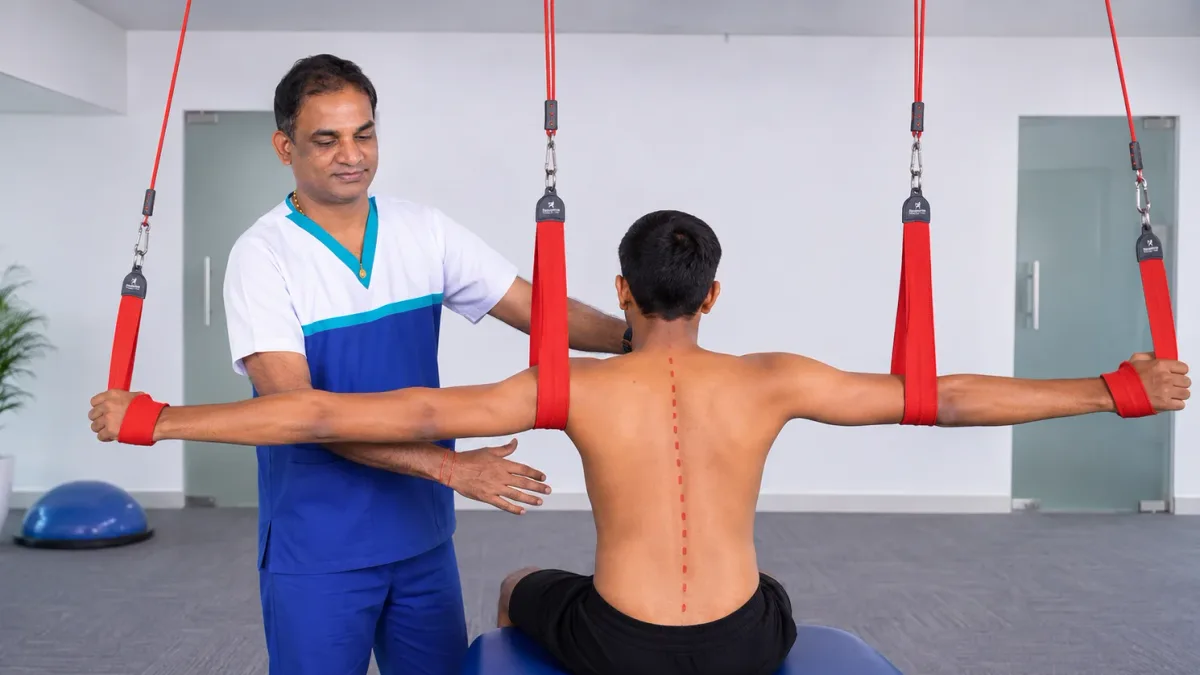
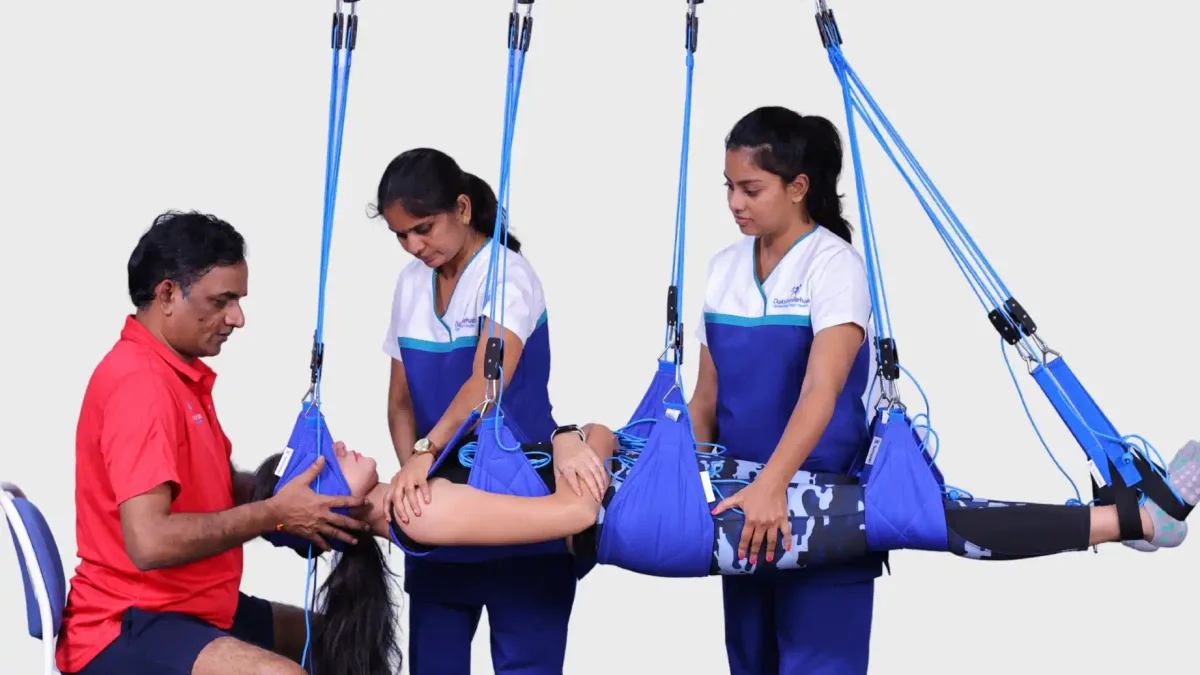
A brace controls a curve from the outside; physiotherapy builds control from the inside. This is where DakshinRehab's core strength shows, because the orthotist and the physiotherapist work as one team rather than in separate clinics. Our scoliosis-trained physiotherapist uses Schroth-inspired, scoliosis-specific exercises, rotational breathing, core stabilisation and postural re-education so the child learns to actively hold the corrected posture, both in the brace and during brace-free hours. Where it helps, we add Clinical Pilates and suspension-based Redcord Neurac rehabilitation to train the deep stabilisers that posture depends on. We explain this pairing in more depth in our guide to Redcord Neurac for scoliosis.
Who needs a scoliosis brace, and who does not
Bracing is generally considered for growing children and adolescents with a flexible curve that is progressing or at risk of progressing, most often in the moderate range during a growth spurt. Very small curves are usually monitored rather than braced, and skeletally mature spines, where the growth window has closed, are typically past the point a brace can change the curve. Adults with degenerative scoliosis are managed differently, with a focus on pain, function and mobility rather than curve correction. We assess each child individually and coordinate with our orthotic and bracing service, and we always say plainly when a brace is not the right tool.
When bracing works best
Timing matters as much as design. A brace is most effective when it is started early in a progressing curve, fitted accurately, verified on an in-brace X-ray, supported by physiotherapy and, crucially, worn for the prescribed number of hours each day. Compliance is part of the treatment, not an optional extra, which is why comfort, fit and follow-up adjustments are built into our process. A technically excellent brace that a child refuses to wear cannot correct anything, so we invest as much in keeping the brace tolerable and the family supported as we do in the engineering.
How growth monitoring keeps the brace corrective
A child's spine is a moving target, so a brace that fits perfectly today can lose its correction within months as the child grows. Regular local reviews let us re-measure, adjust pressure zones, modify or replace the brace and repeat imaging when needed, keeping the correction effective through the whole growth period. Because all of this happens in Moosapet, there is no waiting for an overseas adjustment or shipping a brace back and forth. The same growth-aware approach runs through our pediatric physiotherapy work, where development and posture are tracked together.
Evidence and what to reasonably expect
High-quality evidence, including landmark bracing research and systematic reviews in the orthopaedic and scoliosis literature, supports bracing as an effective way to reduce the risk of curve progression in growing children when the brace is well designed and worn as prescribed. It is important to be honest about what a brace does and does not do: the goal is to stop a curve from getting worse and to support better trunk balance, not to guarantee a permanently straight spine or a cure. Outcomes depend on curve type, maturity, brace quality and wear time, which is exactly why assessment, rectification, verification and follow-up matter so much. For everyday posture habits between sessions, our posture correction guide is a useful companion.
Red flags: when scoliosis needs more than a brace: Some situations call for prompt medical or surgical review rather than bracing. Seek specialist evaluation if a curve is already large at presentation, if it keeps progressing despite a well-fitted brace and good compliance, if the spine has reached skeletal maturity, or if there are neurological signs such as leg weakness, numbness, balance changes or any change in bladder or bowel control. Severe or night pain, fever, unexplained weight loss, or a rib hump that visibly worsens over a few months also warrant urgent assessment. We screen for these honestly and refer promptly when a paediatric orthopaedic surgical opinion is the safer path.
Scoliosis bracing in Moosapet, Hyderabad and for Gulf families: DakshinRehab is located in Moosapet, Kukatpally, serving families across KPHB, Miyapur, Gachibowli and greater Hyderabad, with custom scoliosis bracing, scoliosis-specific physiotherapy and long-term growth monitoring all under one roof. We also support international and Gulf families travelling from the UAE, Saudi Arabia, Qatar, Kuwait and Oman who want assessment-led, X-ray-verified bracing combined with rehabilitation, with the convenience of local follow-up while they are in India. Having the orthotist and physiotherapist in the same clinic keeps the whole plan coordinated as the child grows.
Conclusion
a brace is only as good as the team behind it: A scoliosis brace truly corrects a curve when assessment, expert cast rectification, in-brace X-ray verification, physiotherapy and growth monitoring all work together, not when a particular scanner or software is used. That is why DakshinRehab pairs an experienced orthotist with a scoliosis-trained physiotherapist on every case. To see whether your child needs a brace, and how a corrective one would be built, book your assessment, WhatsApp us on +91 80192 99888, or call +91 80192 99888. The brace is the tool; the team is what makes it correct.