If you or your child has been diagnosed with scoliosis, you have probably heard about bracing and about scoliosis-specific exercise — but rarely about the deep muscles that decide whether a correction actually holds. At DakshinRehab in Moosapet, Hyderabad, we use Redcord NEURAC (NEURomuscular ACtivation), a pain-free suspension-based system developed in Norway, as a key adjunct in our scoliosis treatment programme. NEURAC re-educates the small but powerful intrinsic stabilisers of the spine — the multifidus, transversus abdominis, pelvic floor and deep hip rotators — so the corrected posture achieved by a 3D brace or Schroth session becomes the body's natural, effortless default. This guide explains what NEURAC is, the science of why scoliosis is partly a neuromuscular problem, the honest evidence behind sling-based training, and exactly how we use it for growing children and for adults managing a stable curve.
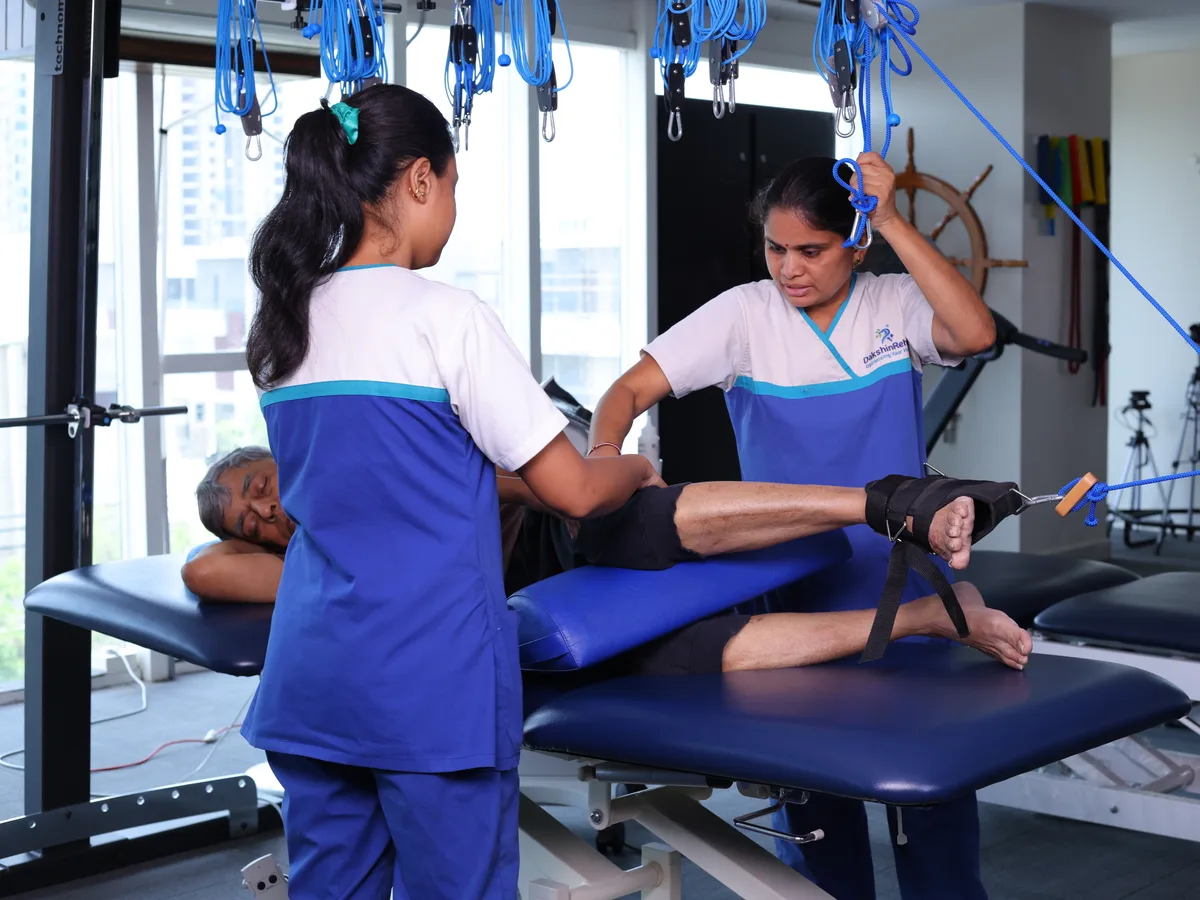
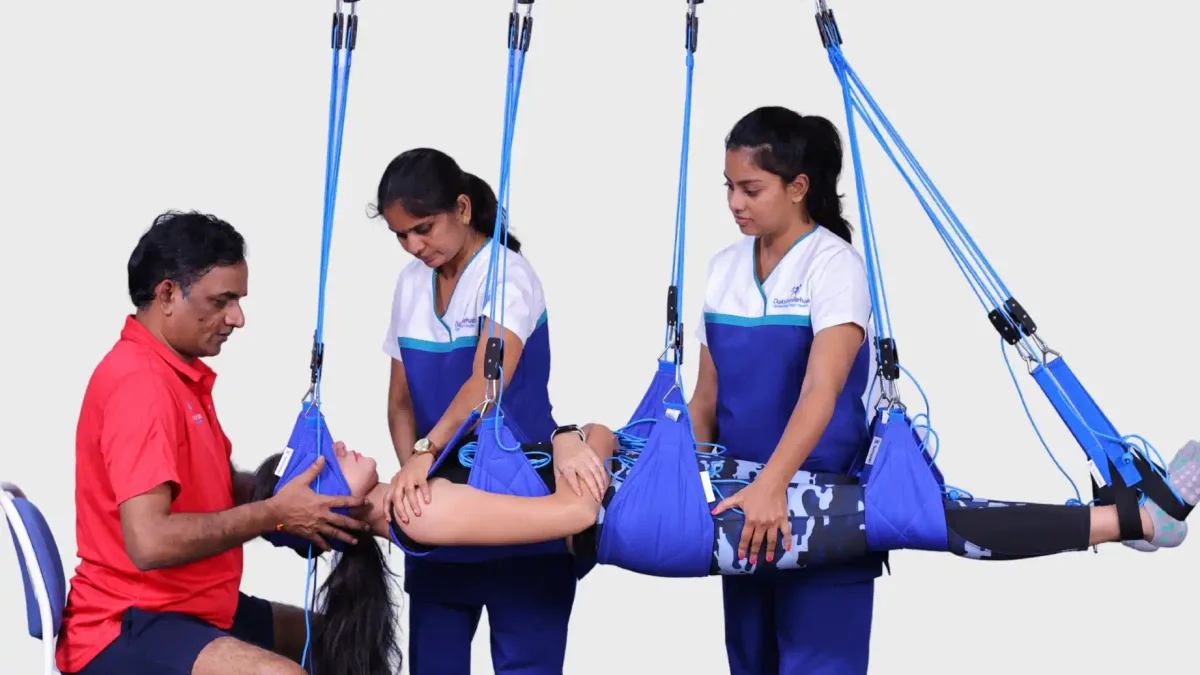
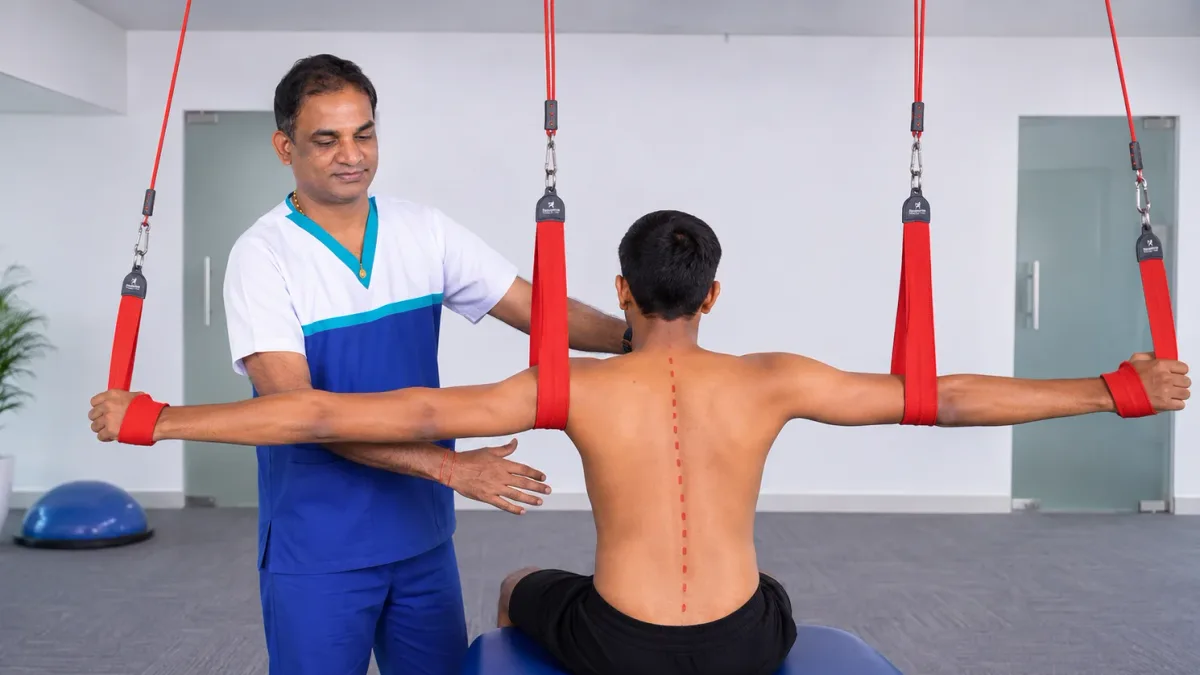
What is Redcord NEURAC, and why is it different? NEURAC is a treatment method that uses an adjustable system of slings, ropes and elastic cords to suspend part or all of the body in a near weightless, antigravity environment. By gently unloading the body, the therapist can switch off the large, dominant muscles — the erector spinae and obliques that scoliosis patients overuse — and ask the deep stabilisers to do the work the brain has stopped asking them to do. The principle is best summed up as 'less is more'
quiet the global muscles, wake the deep ones. Most people feel an immediate change in how tall and balanced they stand, and many describe 'finding' their core for the first time. Unlike isolated gym strengthening, NEURAC trains coordinated movement patterns and muscle chains rather than single muscles, which is exactly what a twisting, three-dimensional spine needs.
Why scoliosis is also a neuromuscular problem, not only a structural one
A scoliotic spine does not just bend sideways — it rotates and changes its front-to-back profile, creating the rib hump and waist asymmetry families notice. One of the most consistent findings in the research literature is reduced activation and poor coordination of the deep intrinsic core on the concave side of the curve. These muscles are meant to act as nature's internal corset, providing segment-by-segment stability and holding you upright against gravity. When they are inhibited, the body compensates by overusing superficial muscles, endurance falls, fatigue and pain rise, and the curve loses the dynamic muscular support that helps resist progression during growth. Strengthening big global muscles alone can actually reinforce the faulty pattern. NEURAC takes the opposite route — it restores the deep stabiliser activation first.
How NEURAC works for a scoliotic spine
A session combines three levers the therapist can fine-tune in real time. First, unloading — by suspending the trunk or limbs, painful segments are offloaded so the patient can move and strengthen without provoking symptoms. Second, instability — the slings create an unstable base that forces the nervous system to recruit the inhibited multifidus and transversus abdominis to keep the spine quiet, which is the heart of neuromuscular re-education. Third, graded load — resistance is dialled up gradually by changing sling height, adding elastic cords, or progressing to more demanding positions, so strengthening is always safe and progressive. Some protocols add gentle vibration through the cords to heighten the stimulus. The goal is never fatigue or pain; it is precise, repeated, correct activation that the brain can carry into everyday posture.
How NEURAC complements 3D bracing rather than replacing it
For a growing child with a curve above roughly 20–25 degrees, a custom 3D corrective brace remains the first-line, evidence-based treatment — NEURAC does not change that. What NEURAC adds is the missing internal half of the equation. A brace supplies an external corrective force; NEURAC builds the internal neuromuscular foundation that lets the spine hold its corrected position once the brace comes off. In practice we schedule NEURAC at two especially valuable moments: early on, to help a child adapt to the brace and learn what 'corrected' feels like, and during the weaning phase, when the deep core must gradually take over the supporting role the brace has been playing. For adults with scoliosis who are not braced, NEURAC becomes a primary tool for pain control and functional stability.
Why the deep core decides whether a correction lasts
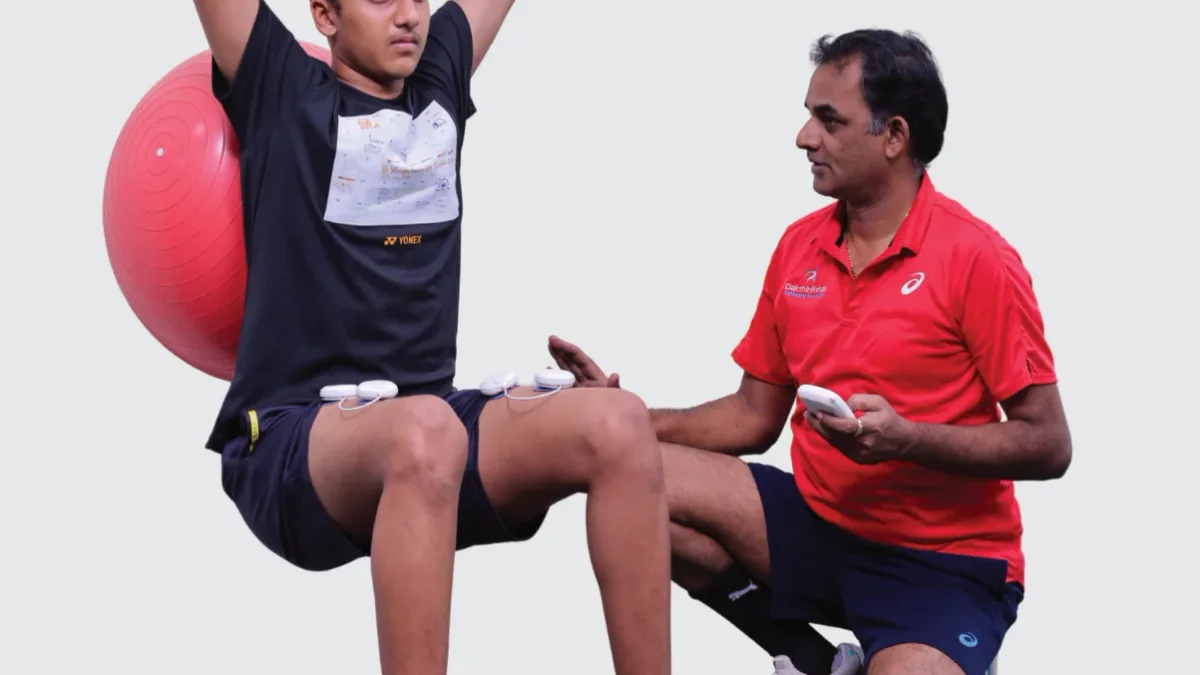
Bracing and Schroth can both improve in-brace and in-session alignment, but the spine spends the other twenty-plus hours of the day under the control of muscles and reflexes. If the multifidus cannot fire reflexively to stabilise each vertebra, the body drifts back toward its habitual curve as soon as conscious effort stops. NEURAC trains exactly this reflexive, automatic stabilisation — high repetition at low load in functional positions builds endurance in the stabilisers so the correction feels natural and is sustained through a school day or a desk job. This is also why we pair NEURAC with EMG biofeedback, which lets the patient see, on screen, which muscles are switching on and learn to balance left-and-right activation around the curve.
How we assess and measure progress at DakshinRehab
Scoliosis is never treated with one tool in isolation here. Every patient begins with a full clinical assessment — standing posture analysis, Adams forward-bend test, scoliometer trunk-rotation reading, flexibility and breathing-pattern screening, and a review of the standing full-spine X-ray, Cobb angle and Risser skeletal-maturity stage. We use movement assessment technologies and posture analysis to capture an objective baseline of trunk symmetry and balance, then re-measure at intervals so progress is tracked by data, not impressions. This baseline also tells us where the deep core is failing, so NEURAC exercises are prescribed to the individual curve pattern rather than from a generic template.
What a typical NEURAC session looks like
A session runs about 45 to 60 minutes. It opens with a brief check-in on pain and posture, then an activation phase in which the therapist positions the patient in the slings — side-lying, four-point crawling, or supported standing — and uses gentle movements to wake the deep stabilisers. The main block is progressive core work: holding a neutral, elongated spine while the arms or legs move, spinal elongation in suspension, and rotational breathing integrated into each hold. We finish with functional integration — standing, walking or bending while keeping the newly found core engagement — and a short, simple home programme such as dead-bug and bird-dog drills. The rule throughout is no pain: if a movement provokes discomfort, the suspension or range is adjusted immediately.
Who should consider NEURAC for scoliosis
NEURAC suits adolescents with scoliosis of any severity who want to get more out of their brace and Schroth programme; adults with curves below the surgical range who have back pain, fatigue or functional limits; and post-surgical scoliosis patients, once their surgeon has cleared them, who need to rebuild deep core control. It also helps anyone with poor postural endurance or core weakness, scoliosis or not. It is engaging — for teenagers especially, suspension work feels more like play than exercise, which improves the compliance that ultimately drives results. NEURAC is not for everyone, though: patients with acute fractures, an unstable spine, or spinal surgery within the past six weeks should avoid suspension exercise until cleared by their doctor.
When NEURAC is not enough — scoliosis red flags that need urgent medical review
Exercise and bracing manage most curves well, but some warning signs mean a specialist or surgical opinion is needed first. Seek prompt medical evaluation if you notice rapid curve progression (several degrees over a few months during growth), a Cobb angle approaching or exceeding 45–50 degrees, new neurological symptoms such as numbness, tingling, leg weakness or changes in bowel or bladder control, severe or night pain, or sudden breathing difficulty. These are not problems suspension therapy can solve, and at DakshinRehab we screen for them at the first visit and refer onward when surgery or further imaging is warranted. Honest expectation-setting is part of safe care: NEURAC can reduce pain and help hold a correction, but it cannot reverse a rigid, mature curve.
Evidence — what the research actually shows
The case for NEURAC in scoliosis rests on the wider evidence for deep-core and sling-based exercise. A 2024 randomized controlled trial in the Journal of Back and Musculoskeletal Rehabilitation found that adolescents with mild idiopathic scoliosis who added sling-based suspension exercise to Schroth therapy over twelve weeks improved their Cobb angle and angle of trunk rotation more than Schroth alone. A Bayesian network meta-analysis of scoliosis exercise trials reported that sling training reduced the Cobb angle by roughly three degrees compared with conventional therapy, and ranked it among the more effective exercise approaches when combined with curve-specific methods. International SOSORT guidelines already recommend scoliosis-specific exercise alongside bracing as gold-standard conservative care, and the landmark BrAIST trial confirmed that bracing itself significantly reduces progression to the surgical range in high-risk adolescents. The honest reading: sling-based neuromuscular work is most powerful as a complement to bracing and Schroth, not as a stand-alone cure.
How NEURAC fits our complete scoliosis pathway
At DakshinRehab our scoliosis care follows SOSORT principles and layers several tools. Growing children with moderate-to-significant curves receive 3D corrective bracing in a Rigo-Chêneau style; every patient receives Schroth or SEAS scoliosis-specific exercise matched to their curve pattern and taught by trained therapists; and NEURAC is woven in as the neuromuscular adjunct that makes both work better. We also draw on related spine programmes — the same deep-core retraining helps our patients with chronic low back pain, spinal stenosis and post-surgical spine recovery. If you want to understand the underlying method more deeply, our guides on Redcord NEURAC suspension therapy and on posture correction exercises are good companion reads, as is our article on chronic back pain physiotherapy.
Who we treat and where — local and Gulf families
Our scoliosis and NEURAC programme runs from the DakshinRehab flagship at 3rd Floor, ARD Magnum, Green Hills Road, Moosapet, Kukatpally, Hyderabad — easily reached from Kukatpally, KPHB, Miyapur, Madhapur, Gachibowli, Hitec City, Kondapur and Nizampet. Because scoliosis care needs frequent, hands-on follow-up — brace adjustments, re-measurement and progressive exercise — being treated locally rather than flying abroad for every modification is a real practical advantage. We also support families travelling from the Gulf — the UAE, Saudi Arabia, Qatar, Kuwait, Bahrain and Oman — who want world-standard, evidence-based scoliosis management with integrated physiotherapy in one place, and we coordinate scheduling so a focused block of assessment, bracing and NEURAC can be completed in a single visit window.
Conclusion — give the correction something to hold onto
Scoliosis is a three-dimensional problem, and lasting management needs more than an external force pushing the spine straight — it needs the deep muscles inside the trunk to learn, and keep, the corrected position. That is what Redcord NEURAC adds at DakshinRehab Moosapet: pain-free, suspension-based neuromuscular activation that turns a brace's or a Schroth session's gains into something the body can sustain on its own, in children during growth and in adults managing a stable curve. Combined with 3D bracing, Schroth or SEAS, Levitas NEURAC therapy, EMG biofeedback and objective movement assessment, it is one of the most complete conservative scoliosis pathways available in Hyderabad. Book your scoliosis assessment, WhatsApp us on +91 80192 99888, or call +91 80192 99888. Bring your child's X-ray, get a clear clinical opinion, and let us show you what the right core can hold.